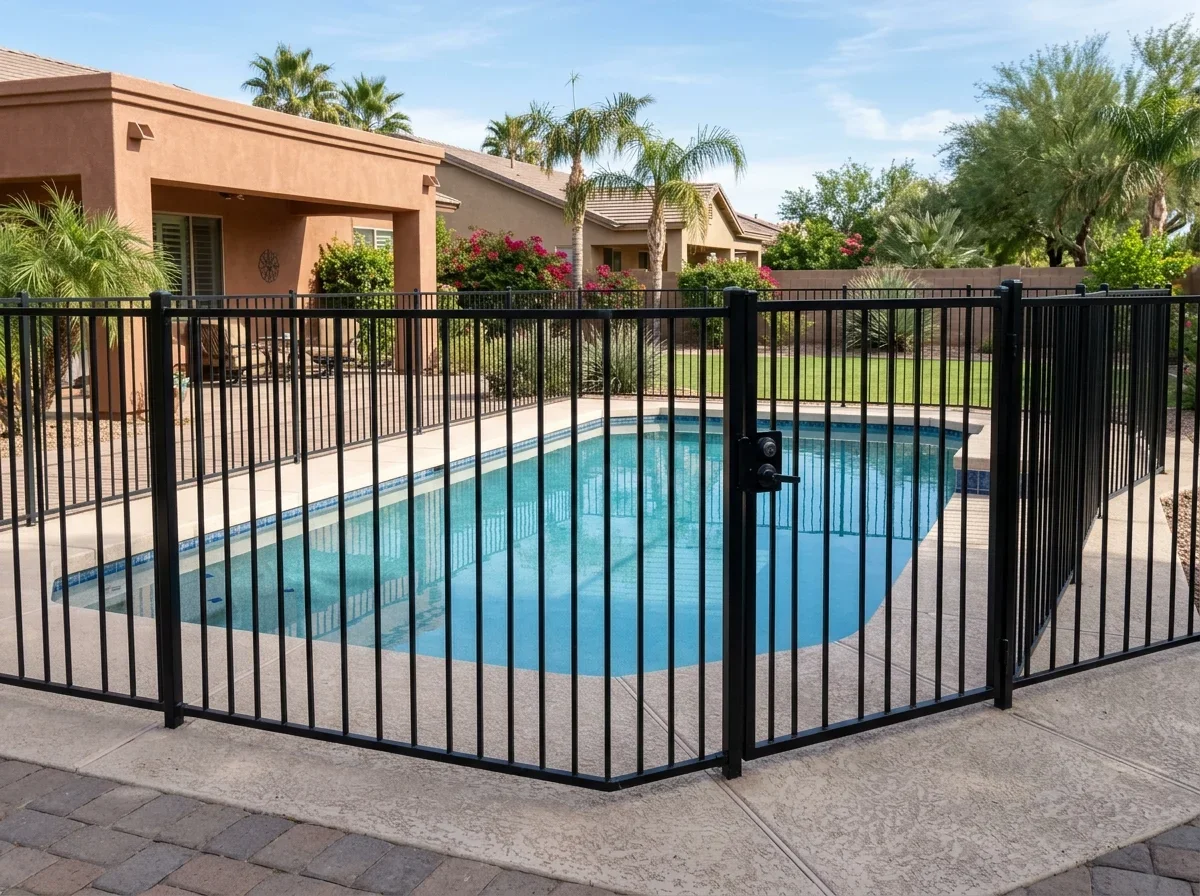
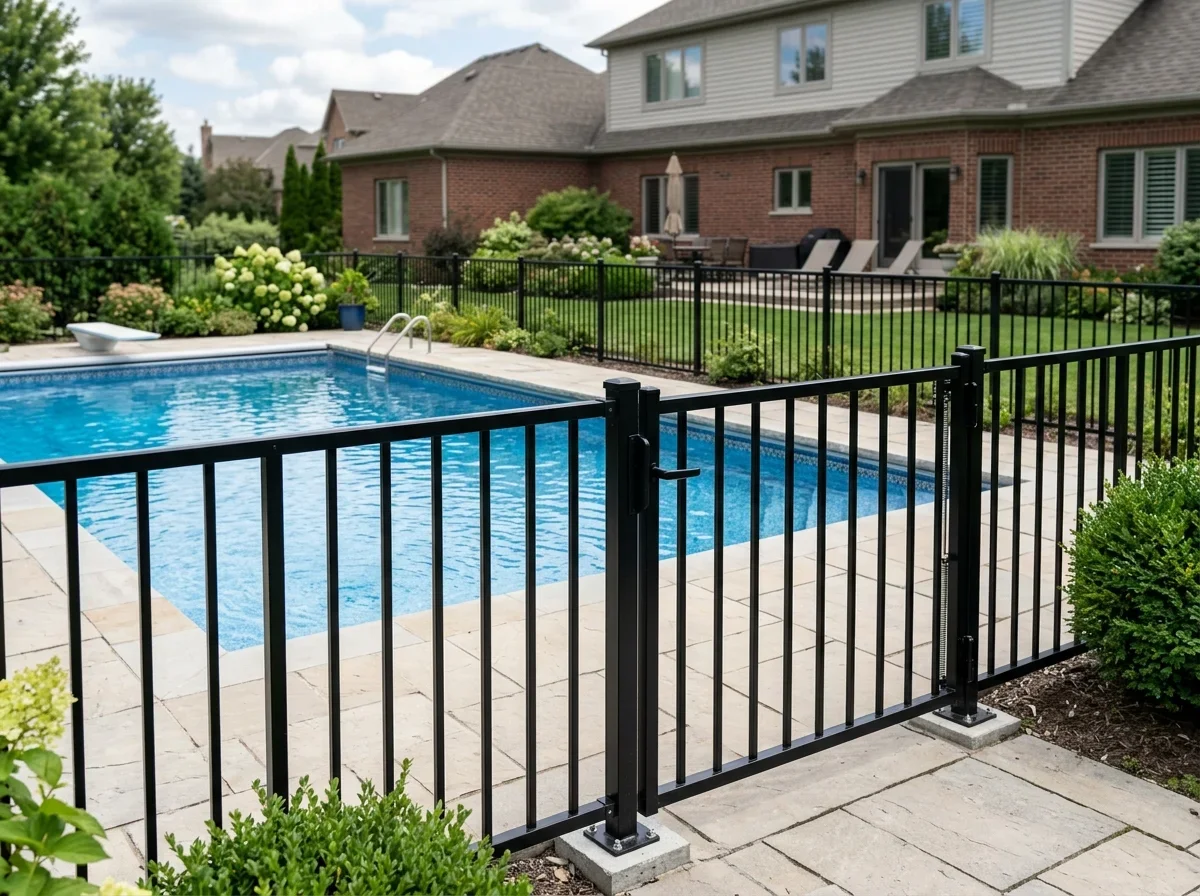
Mesh vs. glass pool fence: the short answer
Pick mesh if you rent, have young kids for a few years, or need to keep the budget tight. Pick glass if you own the home and want a permanent, unobstructed view.
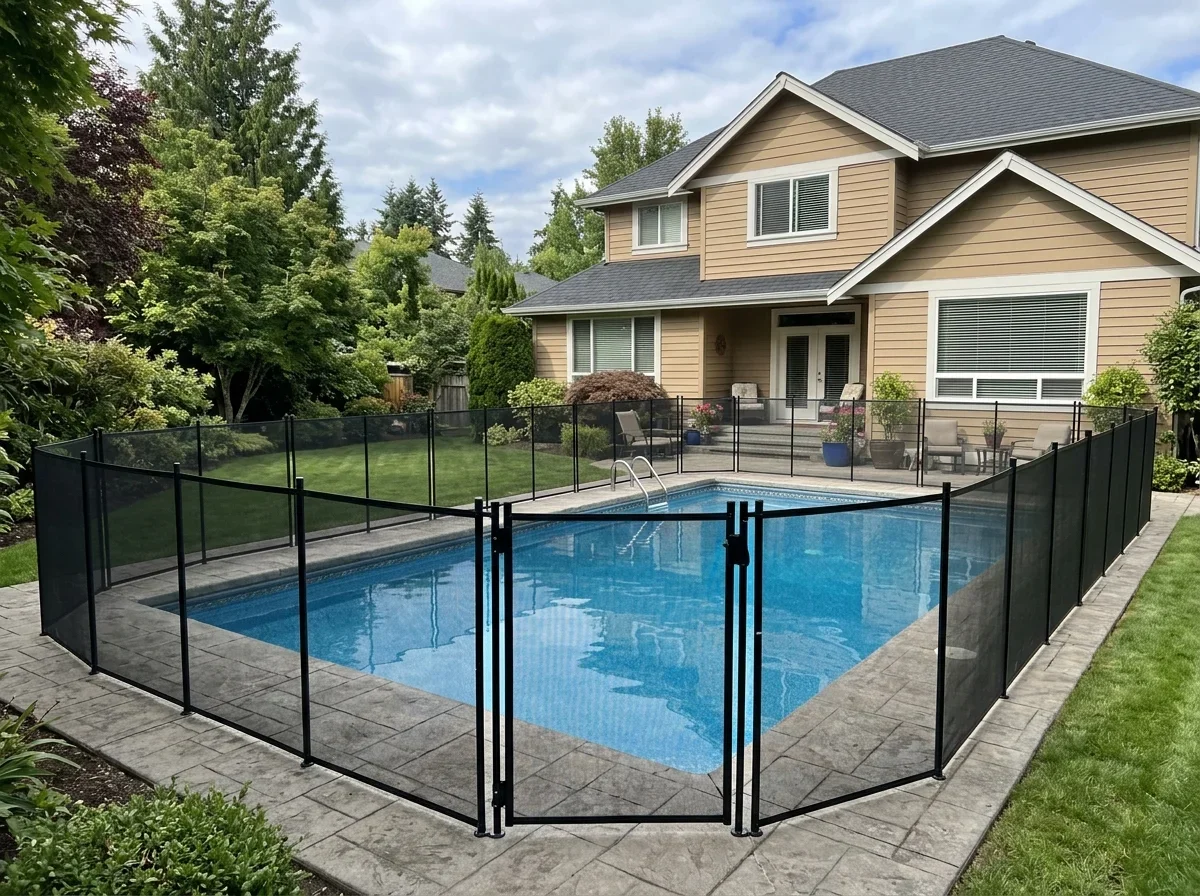
Three types come up in nearly every conversation. Removable mesh is fabric on poles that sit in drilled deck sleeves. Glass comes framed or frameless. Aluminum picket is the common permanent baseline, and it gets a short section below.
Two cases
Which fence to pick
Case A: Mesh
- You rent
- Young kids for a few years
- Tight budget
Case B: Glass
- You own the home
- You want a permanent fence
- Unobstructed view
The table sums up how they stack up. For the rules every option must meet, see our guide to Arizona pool fence law.
| Mesh (removable) | Glass | Aluminum | |
|---|---|---|---|
| View | See-through, but darker and fabric-textured | Nearly clear | Open pickets, more visual presence than glass |
| Removability | Poles lift out of sleeves; fabric rolls up | Permanent | Permanent |
| Upkeep | Check for tears, tension, dirt and UV wear | Water spots and fingerprints need regular cleaning | Generally the lightest cleaning demands |
| Barrier code fit | Must still pass the 4-inch sphere test, 5-foot height and self-closing, self-latching, outward-opening gate rules[1] | Same rules apply, including gate and 20-inch water's-edge clearance[1] | Picket spacing must pass the 4-inch sphere test[1] |
| Best for | Renters, young-kid years, tight budgets | View lots and remodels | Owners wanting privacy, strength and low fuss |
Arizona barrier rules for a removable pool fence
It can, but "removable" is a feature, not an exemption. Arizona law requires a pool enclosure at least 5 feet high, with no opening that a 4-inch sphere can pass through. Gates must be self-closing and self-latching and open outward, and the barrier must sit at least 20 inches from the water's edge.[1]
Your city can adopt rules that are equal to or stricter than the statute.[1] Phoenix aligns its pool code with the statute's five-foot height.[4]
Mesh deserves extra scrutiny. Phoenix's barrier document says mesh fencing must meet ASTM F2286 and lists additional clearance requirements for mesh barriers.[2] Many vendors advertise 48-inch and 54-inch heights, which sit below the 5-foot enclosure figure.
Phoenix also separates a perimeter barrier around the property from an inner barrier around the pool, and doors and windows with direct pool access must comply too.[3] Get the proposed system, gate, deck clearance and layout confirmed with the city before you order.
Pro tip
Compare the finished height of any mesh kit to the 5-foot enclosure rule before you order, since many are advertised at 48 or 54 inches.
Changing or removing an approved barrier can trigger a new permit.[4]
Mesh and glass compared on view, removability and upkeep
View
Mesh is see-through, but it reads darker and carries a fabric texture. Judge it from your normal seating height, not from two feet away.
Glass is the clear winner for an unbroken sightline.
Removability
Mesh poles lift out of drilled sleeves and the fabric rolls up for storage. The sleeves stay in the deck, though, and misplaced holes in concrete or pavers are permanent and hard to hide.
Side by side
Removability: mesh versus glass
Mesh
- Poles lift out of sleeves
- Fabric rolls up
- Sleeves stay in the deck
Glass
- Permanent
- Cannot come down for a party
Glass cannot come down for a party or a resale photo shoot.
Taking mesh down also takes the protection with it. If the fence is the approved barrier, a gap in coverage is a safety and compliance problem.
Upkeep
Glass shows water spots and mineral deposits, and Phoenix-area water is very hard at 300+ ppm calcium carbonate. Mesh needs periodic checks for tears and tension, plus a rinse for dust, leaves and sunscreen.
Desert UV and 106°F summer highs make heat and sun exposure fair questions. Ask each manufacturer for UV and warranty terms in writing.
Installation matters as much as material. Ask whether caliche, the hardpan found 1 to 6 feet down in much of the Valley, could make drilling harder than "easy DIY" kits imply.
A licensed installer can handle that, and our pool fence and safety barrier installation page can help you find one. The ROC's B-5 General Swimming Pool Contractor class includes installing code-required pool barriers.[6]
Where aluminum pool fencing fits
Aluminum is the usual permanent alternative. It gives you more privacy and strength than mesh and less view than glass, and it generally asks less of you in cleaning.
It still has to pass the same test. Picket spacing must stop a 4-inch sphere, and gates follow the same self-closing, self-latching rules.[1]
Key takeaways
- Removable does not mean exempt from barrier rules
- Every fence type must pass the 4-inch sphere test and meet the 5-foot height
- Mesh suits renters and young-kid years; glass suits owners wanting a view
- Aluminum is the permanent, low-fuss option
Choosing the right fence for a Phoenix-area yard
Start with how long you need the fence and what you want to see from the patio. Then settle the paperwork before you drill anything.
Pool fence ideas by yard type
These are illustrative cues, not city rules.
- Small lots in Mesa, Tempe or Chandler: Mesh keeps the yard feeling open, and you can store it when the pool is empty or the kids have outgrown it.
- View lots in Scottsdale: Glass protects the sightline. Scottsdale requires separate permits for pools, spas and fences, so plan for each.[5]
- Kid-heavy yards in Gilbert or Surprise: Mesh fits the early years, and aluminum suits families who want a permanent, low-maintenance answer.
- Remodels: A permanent glass or aluminum fence can be planned alongside pool and deck changes. Our pool remodel and renovation page covers that work.
- Budget perimeters: Mesh is generally the lower-cost route. Quotes vary, so compare written scopes, not headline numbers.
Before you buy, run this quick check:
- Confirm with the City of Phoenix, or your own city, that your proposed system is accepted.
- Compare the finished height to the 5-foot enclosure rule.
- Check the 4-inch sphere test and the gate and latch requirements.
- Settle who pulls the permit. Don't assume a removable fence skips one.
- Verify the installer's license class on the Arizona Registrar of Contractors lookup at roc.az.gov.
For budget context, see pool fence cost in Arizona.
Frequently asked questions
Is a removable mesh pool fence legal in Arizona?
It can be, if the system and installation meet the state barrier rules and your city's requirements.[1] Phoenix requires mesh to meet ASTM F2286 and adds clearance rules.[2]
Confirm acceptance with your city, and read our barrier law guide.
What are some good fence pool ideas for a small backyard?
Mesh keeps a tight yard feeling open and can come down when the pool isn't in use. Glass keeps sightlines clear in a compact space.
What are the best pool safety fence ideas for families with young kids?
Mesh suits the years when a child is small, and aluminum suits families who want something permanent. Either way, prioritize a self-closing, self-latching gate that opens outward.
Is a glass pool fence safe and does it meet code?
Glass can work as a barrier when the design meets the height, gate and clearance rules.[1] Local acceptance still needs confirming with your city.
Is a pool aluminum fence better than mesh or glass?
It depends on your priorities. Aluminum is durable, permanent and easy to keep up, but it blocks more of the view than glass and can't be taken down like mesh.
Can I take a removable pool fence down when the pool is in use?
Removal is your decision, but a down fence protects no one. If it's your approved barrier, another compliant barrier needs to stay in place, and removing it may require a new permit.[4]
Questions
- Arizona Legislature. "A.R.S. § 36-1681 — Pool enclosures; requirements; exceptions." https://www.azleg.gov/ars/36/01681.htm. Accessed October 17, 2026.
- City of Phoenix Planning and Development Department. "Pool Barriers – Requirements." https://www.phoenix.gov/content/dam/phoenix/pddsite/documents/trt/external/dsd_trt_pdf_00144.pdf. Accessed October 17, 2026.
- City of Phoenix Planning and Development Department. "Pool Barrier Enforcement Procedure." https://www.phoenix.gov/content/dam/phoenix/pddsite/documents/trt/external/dsd_trt_pdf_00700.pdf. Accessed October 17, 2026.
- City of Phoenix. "2024 International Swimming Pool and Spa Code." https://www.phoenix.gov/content/dam/phoenix/pddsite/documents/codes-ordinances/amendmentcodes/2024-ispcs.pdf. Accessed October 17, 2026.
- City of Scottsdale. "Submittal packet for minor SFR remodel/addition." https://www.scottsdaleaz.gov/docs/default-source/scottsdaleaz/planning---develpment/permit-services/submittal-packet-for-minor-sfr-remodel-addition.pdf?sfvrsn=aec46e97_3. Accessed October 17, 2026.
- Arizona Registrar of Contractors. "License Classifications." https://roc.az.gov/license-classifications. Accessed October 17, 2026.