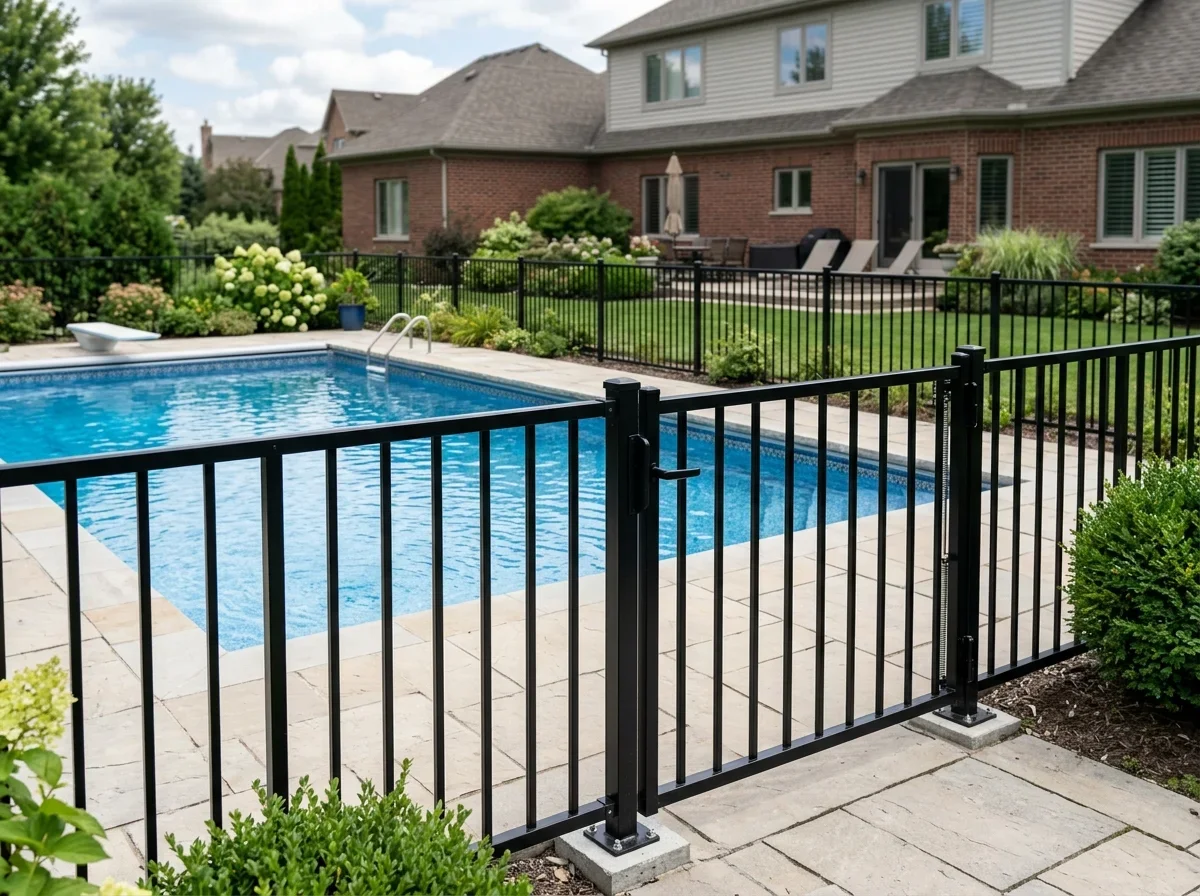
Is a pool fence legally required in Arizona?
Yes, for pools that meet the statute's size trigger. A.R.S. § 36-1681 requires an enclosure around a swimming pool or other contained body of water intended for swimming when the water is at least 18 inches deep at any point and wider than 8 feet at any point.[1] You can read the wording yourself at azleg.gov.
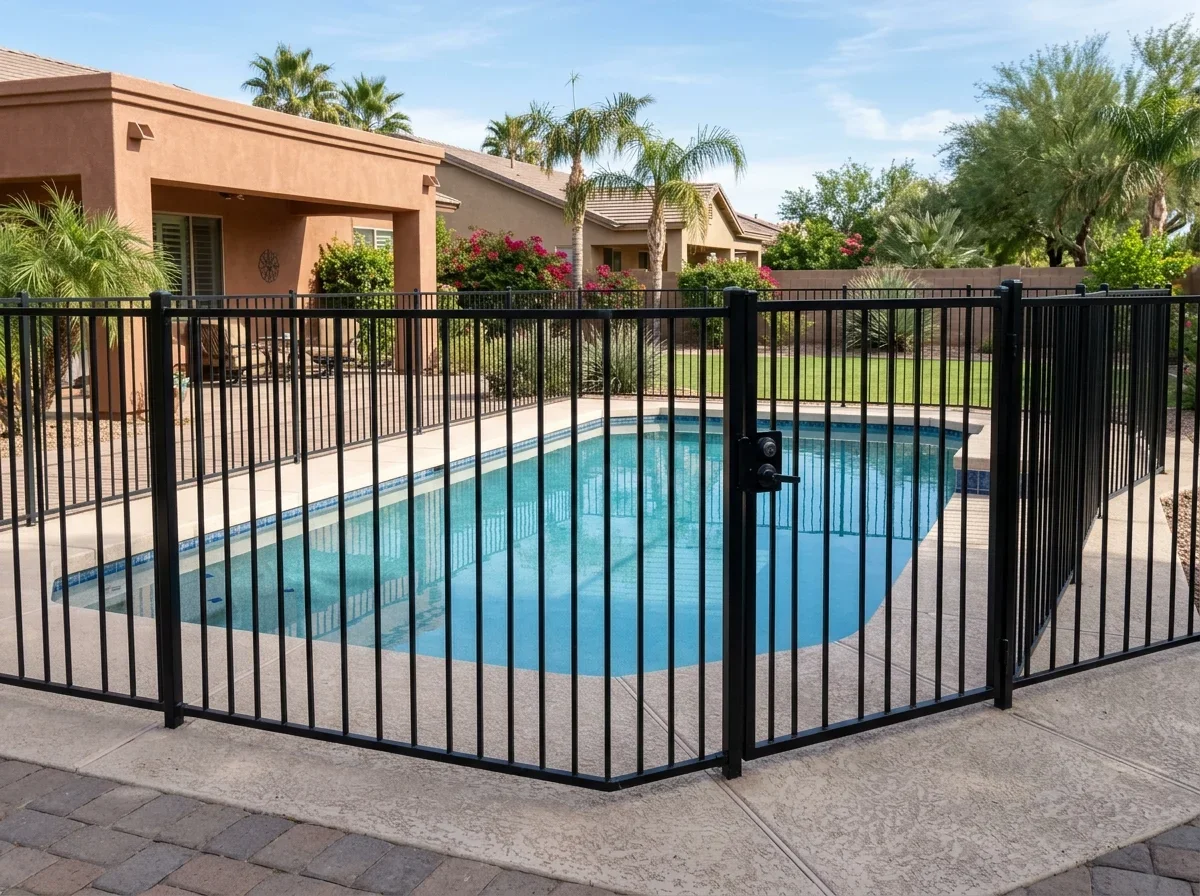
Notice the word "enclosure." The law is a barrier requirement, not strictly a fence requirement.
Phoenix describes an inner barrier around the pool that may be a separate fence or a barrier formed partly by the dwelling. It says doors and windows with direct pool access must comply too.[3]
State law is only the floor. Cities and counties can apply rules that match or exceed it, so a yard that satisfies the statute still needs a check against local requirements.
Pools the state barrier law covers
The trigger is size, not ownership type or neighborhood. Water 18 inches or deeper and wider than 8 feet brings a pool under the statute.[1]
Some questions sit outside what the verified statute summary settles. Whether the rule treats new and existing pools differently, how spas and hot tubs are handled, and any exemptions all depend on the full statute text and your local building department. Phoenix, for one, requires barriers for swimming pools, spas and hot tubs in its own policy.[5]
Physical specs a pool barrier must meet
The statute sets four physical specs. Each is easy to test in your own yard with a tape measure.
Height and the 4-inch sphere
The enclosure must be at least 5 feet high, and it can have no opening large enough for a 4-inch sphere to pass through.[1] Phoenix adds that it measures the 5 feet from the exterior side of the barrier.[2] Where other cities measure from is a question for their building departments.
In homeowner terms, the sphere rule covers gaps under the fence, spaces between pickets, and the openings in mesh panels. A 4-inch ball is roughly the size of a softball.
Phoenix also says an approved barrier must stay in place for the life of the pool.[2]
Gates and distance from the water
Gates need to be self-closing and self-latching, and they open outward, away from the pool.[5] Latches placed out of a small child's reach add a margin the statute doesn't spell out.
The barrier must also sit at least 20 inches from the water's edge.[1] Fences built tight against the coping are a common miss.
| Requirement | What the state statute says | What to check locally |
|---|---|---|
| Pools covered | Water at least 18 inches deep and wider than 8 feet | Your city or county building department for spas and other cases |
| Minimum barrier height | At least 5 feet | How your city measures height, such as the City of Phoenix barrier page |
| Openings (4-inch sphere) | No opening a 4-inch sphere can pass through | Local interpretation of materials such as mesh |
| Gates | Self-closing and self-latching, opening outward away from the pool | Local gate and door requirements |
| Distance from water's edge | At least 20 inches | Any stricter local spacing rule |
| Permit | Not covered in the verified statute summary | Your city or county permit office |
Use the table as a checklist for your own yard, then confirm each local cell with the office that issues your permit.
How the parts connect
Parts of a compliant pool barrier
Barrier at least 5 feet high
Measured from the exterior side in Phoenix
No opening over 4 inches
Gaps, pickets and mesh
Self-closing, self-latching gate
Opens outward, away from the pool
At least 20 inches from the water's edge
Pool barrier rules in Phoenix, Mesa and Scottsdale
Phoenix publishes the most for homeowners. Its Planning and Development Department posts barrier requirements, an enforcement procedure and a materials interpretation. It also says an approved barrier needs a new permit if it is enlarged, altered, repaired, removed, converted or replaced.[2]
Start with the City of Phoenix Pool Barriers page.
Scottsdale requires separate permits for pools, spas and fences, and its pool permit application asks for the contractor's ROC number. Mesa lists permits for pool work and a Contractor Licensure Verification Form among its required documents.
In unincorporated areas, Maricopa County issues residential permits for pools, spas and pool barriers.
For Chandler, Tempe, Glendale and Gilbert, call the building department and ask for the barrier requirements in writing. If you're planning a remodel, the Phoenix pool remodel permit guide covers survey waivers and setbacks, which are separate from barrier rules.
Pro tip
Ask the building department to put the barrier requirements in writing, and keep that page with your permit paperwork.
Temporary and removable fences under the barrier rules
Compliance depends on the spec, not the product category. A removable barrier would need to meet the same 5-foot height, 4-inch sphere limit and gate requirements, and your city has to accept it.[1] Phoenix publishes a materials interpretation that addresses what it accepts, so read that before ordering.[2]
No product type is automatically approved. For a comparison of mesh and glass options, see removable mesh vs. glass pool fence.
Contractor licensing and who pulls the barrier permit
The Arizona Registrar of Contractors (ROC) B-5 General Swimming Pool Contractor classification includes installing code-required pool barriers around a pool or spa.[4] See the ROC license classifications and our breakdown of R-6, B-5 and KA-5 licenses.
Before signing, use the ROC Contractor Search at roc.az.gov/before-hire to confirm:
- The license is active.
- The classification covers barrier work.
- Bond and Recovery Fund status are in good standing.
Those checks take minutes. They matter because owners who hire unlicensed entities have no ROC recourse.
Checklist
Before you hire a barrier installer
0 of 4 ticked
Tick them off as you go. Nothing is saved or sent.
Permits are the owner's responsibility unless your contract says otherwise, so settle who pulls them in writing. Barrier work usually needs a permit, which means the narrow exemption for casual, minor work under $1,000 will rarely apply.
Compare vetted installers on our pool fence and safety barrier installation page.
Pool fence law FAQ
Is it a legal requirement to have a pool fence in Arizona?
Yes, if the pool is at least 18 inches deep and wider than 8 feet. A.R.S. § 36-1681 requires an enclosure that meets the height, opening and distance specs.[1] Cities can add stricter rules.
Do I legally have to have a fence around my pool?
You need a compliant enclosure, which may not be a standalone fence. Phoenix says the inner barrier can be a separate fence or one formed partly by the dwelling.[3]
How high does a pool fence have to be in Arizona?
Are temporary pool fences allowed in Arizona?
Only if they meet the same height, sphere and gate specs and your city accepts them. Confirm with the building department before buying.
What is the typical cost of a pool fence in Arizona?
Cost depends on materials, gates and yard layout, and our pool fence cost guide breaks down what drives the price.
Before you buy or hire, confirm the requirements with your local building department.
Questions
- Arizona Legislature. "A.R.S. § 36-1681 — Pool enclosures; requirements; exceptions." https://www.azleg.gov/ars/36/01681.htm. Accessed October 17, 2026.
- City of Phoenix Planning and Development Department. "Pool Barriers – Requirements." https://www.phoenix.gov/content/dam/phoenix/pddsite/documents/trt/external/dsd_trt_pdf_00144.pdf. Accessed October 17, 2026.
- City of Phoenix Planning and Development Department. "Pool Barrier Enforcement Procedure." https://www.phoenix.gov/content/dam/phoenix/pddsite/documents/trt/external/dsd_trt_pdf_00700.pdf. Accessed October 17, 2026.
- Arizona Registrar of Contractors. "License Classifications." https://roc.az.gov/license-classifications. Accessed October 17, 2026.
- City of Phoenix. "Pool Policy." https://www.phoenix.gov/administration/departments/housing/section-8-housing/section-8-inspections/pool-policy.html. Accessed October 17, 2026.