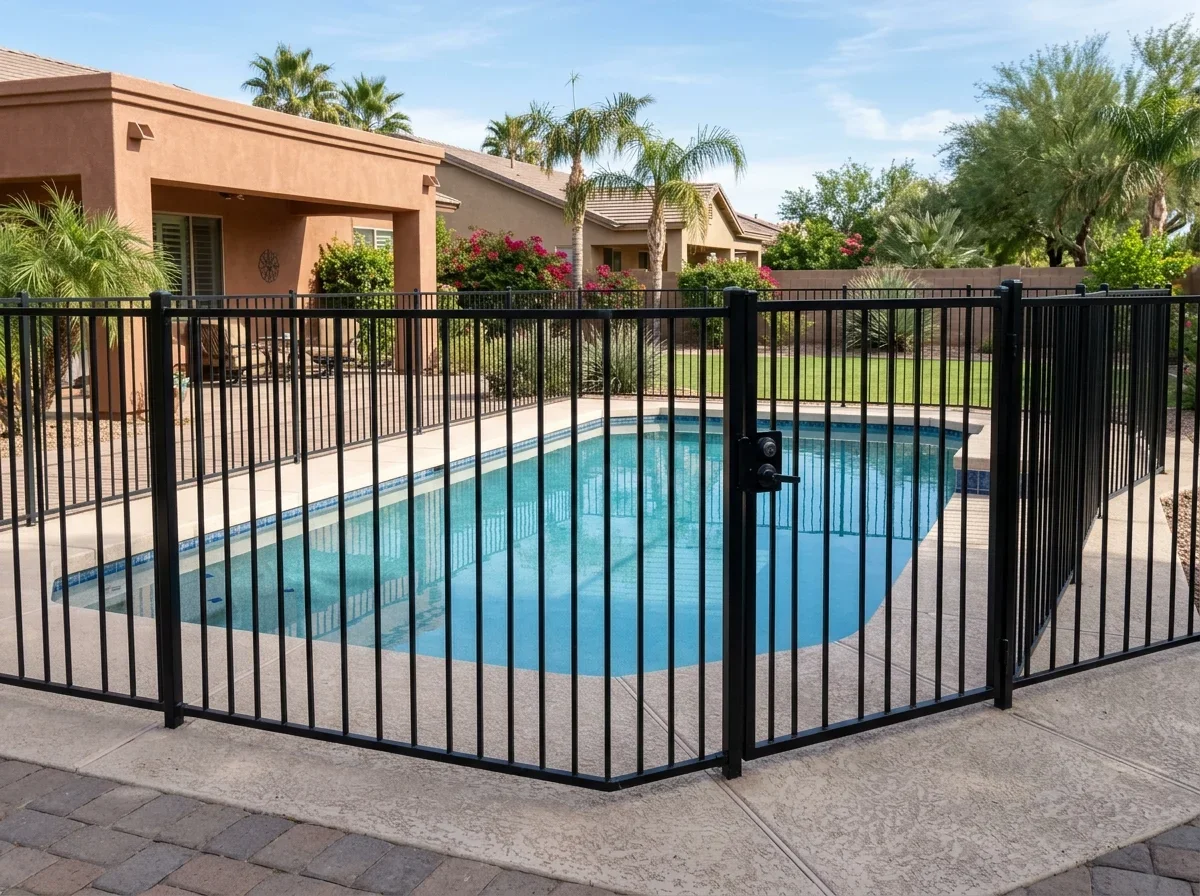
How much does a pool fence cost in the Phoenix area?
A pool fence costs the length of your barrier line in feet multiplied by a per-foot rate for the material, plus gates, removal of any old fence, permit handling and labor. Material, gate count, site conditions and who pulls the permit drive most of the swing between bids.
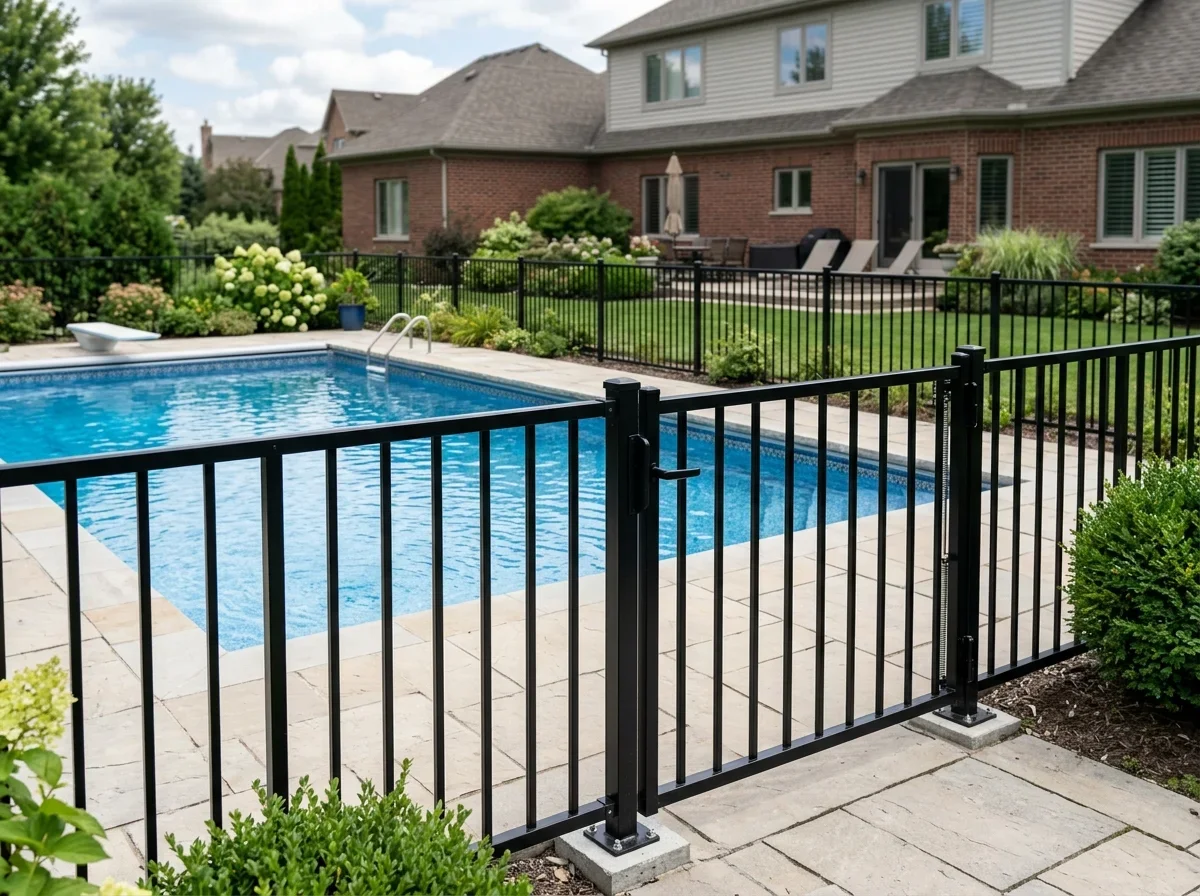
Phoenix-area pool companies' own websites, checked October 2026, did not print per-foot fence rates we can quote here. Per-foot figures come from national or regional cost guides, so treat them as a rough tier comparison, not a Phoenix quote.
How to measure and calculate your footage
Measure the barrier line, not the pool. That means every foot of fence, wall or gate between the yard and the water, including runs around a patio if the barrier encloses it.
The method looks like this: barrier line in feet × rate per foot from your quote, then add gates, removal, permit and labor lines. That is also how to answer "how much would 500 feet cost." Multiply 500 by the rate on your written quote, then add the extras.
How it works
How to calculate your fence cost
Step 1: Measure the barrier line in feet
Every foot of fence, wall or gate between the yard and the water
Step 2: Multiply by the per-foot rate on your written quote
Step 3: Add gates, removal, permit and labor lines
An existing block wall or shared yard wall can cut your footage. It still has to meet the barrier spec, including the distance from the water, so have the installer check it before you count it as free.
| Material | Cost per linear foot (sourced range) | Gate and hardware notes | Upkeep and sun exposure | Code fit (4-inch sphere, 5 ft height) |
|---|---|---|---|---|
| Removable mesh | Lowest tier; get the rate from a dated installer or guide page | Gate must self-close and self-latch; confirm it is included | Ask the maker about UV rating and warranty | Can fit if mesh openings stay under the 4-inch sphere and height reaches 5 ft [1] |
| Permanent mesh (no-drill or post-set) | Low to mid tier; confirm source and date | Check closing force and latch height | Ask about finish and fabric warranty | Same test applies; check post spacing |
| Aluminum | Mid to high tier | Gate may be priced separately | Ask about powder-coat finish warranty | Picket spacing must pass the sphere test [1] |
| Wrought iron | Mid to high tier | Heavier gates need stronger hinges | Ask about rust protection and coating | Same spacing and height checks |
| Tempered glass | Highest tier | Hardware is often specialized | Ask about glass and hinge warranties | Solid panels have no openings, but gate and height still apply |
Fence material as a price driver
Material sets the cost tier, but it also sets the upkeep you live with and how easily a fence passes the spec. Whatever you pick must be at least five feet high with no opening that lets a four-inch sphere pass through.[1]
Mesh and removable fences
Mesh is the lowest tier per foot, and removable versions can come out when you need the yard clear. The trade-off is visible posts and fabric, and the need for correct tension and post spacing so sections don't sag.
Removable sleeves need holes core-drilled into concrete decking. Ask whether that drilling is included.
Side by side
Mesh versus higher-tier fences
Removable mesh
- Lowest tier per foot
- Can come out when you need the yard clear
- Visible posts and fabric
Aluminum, iron and glass
- Higher tiers
- More permanent, finished look
- Posts may hit caliche
Aluminum, wrought iron and glass
These are the higher tiers, with a more permanent, finished look. Posts set in the ground can run into caliche hardpan, which sits one to six feet down in much of the Phoenix area. Ask whether post holes through caliche are priced as a separate line.
Price factors
What changes a pool fence price
Material
Mesh is the lowest tier, glass the highest
Gates
Self-closing, self-latching hardware is a required line item
Site conditions
Caliche, uneven ground or a gate in a house wall can add custom work
Permit and removal
Quotes either include them or they are extra lines
Glass sits at the top of the price scale in published guides. Glass replacement cost depends on the type of glass, the frame, and how the window is installed. Get itemized quotes to compare. That is national data, not a Phoenix quote.
For a side-by-side view, see Removable Mesh vs. Glass Pool Fence. If you want help choosing a compliant material, start with Pool Fence and Safety Barrier Installation.
Gate and hardware costs in a pool fence quote
The gate is where cheap quotes tend to get cheap.
Arizona requires pool gates to be self-closing and self-latching, and to open outward, away from the pool.[1] Phoenix's published policy says the same.[4] Those are required line items, not upgrades.
Ask what's included:
- Self-closing hinges and a self-latching mechanism
- Lockable latch options or alarms, and whether they cost extra
- Final adjustment and testing after install
A gate set into a house wall, a patio edge or uneven ground can need custom work. Ask for it as its own line so you can compare bids fairly.
If a bid is far below the rest, check the gate line first. It may leave out compliant hardware.
Pro tip
Ask every contractor to price the same gate hardware, self-closing, self-latching and outward-swinging, so low bids are not just missing compliant parts.
Arizona code rules that shape the quote
The state rule shapes the quote. Pools with contained water 18 inches or more deep and wider than 8 feet need a barrier.[5] The enclosure must be at least five feet high, with no opening a four-inch sphere can pass through, and the barrier must sit at least 20 inches from the water's edge.[1]
Local rules can be equal or stricter. Phoenix publishes its own barrier requirements, including the five-foot height and four-inch ball limit, and requires a new permit to alter, repair, remove or replace an approved barrier.[2]
A fence set closer than 20 inches to the water may need to move. For the full list of rules, read Arizona Pool Fence Law.
Key takeaways
- Barriers are needed for water 18 inches or more deep and wider than 8 feet
- The fence must be at least five feet high
- No opening can pass a four-inch sphere
- The barrier must sit at least 20 inches from the water's edge
Permit and contractor licensing costs
Permits are the owner's responsibility unless your contract says otherwise. A quote either includes permit handling or it doesn't, and you need to know which.
Maricopa County states that outdoor pool-barrier permits must be issued before the barrier is installed.[5] Scottsdale requires a fence permit for new fences, and pool plans must show the location and height of the barrier.[3]
Permit fees differ by city, so check with the building department directly.
Verify the contractor's license on the Arizona Registrar of Contractors lookup at roc.az.gov. Barrier work falls under a pool license class, so confirm the class covers it. For the classes, see R-6, B-5 or KA-5.
Arizona allows only narrow unlicensed work, limited to jobs under $1,000 that are casual or minor, need no local permit and aren't part of a larger job.[7] A full pool barrier rarely qualifies.
For the Phoenix setback and survey waiver points that can affect a fence near a lot line, see Phoenix Pool Remodel: Survey Waivers, Setbacks and Permits.
Comparing pool fence quotes line by line
Compare the same footprint across every bid. Then go line by line, not total to total.
- Footage of barrier line and the footprint it covers
- Material and height
- Gate count and hardware (self-closing, self-latching, outward swing)
- Removal and disposal of an old fence
- Permit handling and who schedules inspection
- What happens if the work fails inspection
- Warranty
- License number and class
- Deposit and payment schedule
Arizona requires contracts over $1,000 to be in writing, with the license number, the price, the deposit and the payment stages.[6] Avoid paying in cash or ahead of the work.
"Licensed, bonded and insured" in an ad proves nothing about insurance, so ask for a certificate. For more on this, see Is 'Licensed, Bonded and Insured' Enough in Arizona?.
Pool fence cost FAQ
How much does it cost to put a fence around a pool?
It depends on your barrier-line footage, the material, the number of gates and the permit and removal lines. Get an itemized written quote.
How much would 500 feet of fence cost?
Multiply 500 by the per-foot rate on your quote, then add gates, removal, permit and labor lines.
Do I legally need a fence around my pool?
Generally yes, if the water is 18 inches or more deep and wider than 8 feet.[5] Read Arizona Pool Fence Law for the full requirements.
Which removable pool fence is the best?
No single brand fits every yard. Compare how well each product holds tension, how its gate closes and latches, whether the openings stay under the four-inch limit, and what warranty the installer offers.
How much does a mesh pool fence cost per foot?
Mesh sits in the lowest cost tier per foot. For a figure, use a dated installer or cost-guide page and label it as national or regional.
Does a pool fence need a permit in Phoenix?
Phoenix requires a new permit to enlarge, alter, repair, remove, convert or replace an existing approved pool barrier.[2] Confirm the details for your project with the City of Phoenix permit desk.
Questions
- Arizona Legislature. "36-1681 - Pool enclosures; requirements; exceptions." https://www.azleg.gov/ars/36/01681.htm. Accessed October 17, 2026.
- City of Phoenix. "Pool Barriers – Requirements." https://www.phoenix.gov/content/dam/phoenix/pddsite/documents/trt/external/dsd_trt_pdf_00144.pdf. Accessed October 17, 2026.
- City of Scottsdale. "Swimming Pools, Hot Tubs and Spas." https://www.scottsdaleaz.gov/codes-and-ordinances/swimming-pools. Accessed October 17, 2026.
- City of Phoenix. "Pool Policy." https://www.phoenix.gov/administration/departments/housing/section-8-housing/pool-policy.html. Accessed October 17, 2026.
- Maricopa County. "Residential Pool and Barrier requirements." https://www.maricopa.gov/DocumentCenter/View/69465/Pool-Barrier-Requirements. Accessed October 17, 2026.
- Arizona Legislature. "32-1158 - Contract requirements; provision of documents and receipt at contract signing." https://www.azleg.gov/ars/32/01158.htm. Accessed October 17, 2026.
- Arizona Legislature. "32-1121 - Persons not required to be licensed; penalties; applicability." https://www.azleg.gov/ars/32/01121.htm. Accessed October 17, 2026.