Arizona has several pool contractor license classes, not one
No. The Arizona Registrar of Contractors (ROC) licenses pool work under several classes: R-6, CR-6, B-5, B-6, KA-5 and KA-6. Which one your contractor needs depends on the job.[1]
The letters tell you the market. R means residential, C means commercial, and K means dual (both). B-5 is the residential general pool class, and KA-5 is its dual counterpart.[1]
| Class | Residential / commercial / dual | Typically covers | Does not cover | Example homeowner jobs |
|---|---|---|---|---|
| R-6 | Residential | Service and minor repair of residential pools | Potable-water plumbing connections, gas lines, gas chlorine systems, electrical beyond the first disconnect, full replacement of plaster, pebble or decks | Pump or filter swap, leak repair |
| CR-6 | Dual (C-6 plus R-6) | Residential R-6 scope plus commercial pool service and repair | Same limits as R-6 for residential work | Pump or filter swap, leak repair |
| B-5 | Residential | Construction and repair of pools and spas, code-required barriers, utilities from the service point to the equipment | Solar heating (B-6 adds it) | Replaster, remodel, safety fence |
| B-6 | Residential | Everything in B-5 plus solar-heating installation and repair | Confirm anything unusual with the ROC | Remodel with solar heating |
| KA-5 | Dual (commercial A-9 plus residential B-5) | B-5 scope plus commercial pool work | Solar heating (KA-6 adds it) | Remodel or rebuild |
| KA-6 | Dual | KA-5 scope plus solar heating | Confirm anything unusual with the ROC | Remodel with solar heating |
Scopes come from the ROC's classification pages, so check the current wording at roc.az.gov/license-classifications.[1]
Pure cleaning, testing and chemical balancing is a different question. See pool service and maintenance, and confirm any exemption with the ROC or A.R.S. 32-1121.
Scope of the R-6 and CR-6 pool classes
R-6 covers service and minor repair of residential pools. CR-6 is the dual class that combines the commercial C-6 and residential R-6 scopes.[1]
An R-6 scope leaves out potable-water plumbing connections, gas lines, gas chlorine systems, electrical work beyond the first disconnect, and complete replacement of plaster or pebble interiors and decks.[1]
Side by side
R-6 versus B-5 scope
R-6
- Service and minor repair of residential pools
- No full plaster, pebble or deck replacement
- No gas lines or potable-water connections
B-5
- Construction and repair of pools and spas
- Code-required barriers
- Utilities from the service point to the equipment
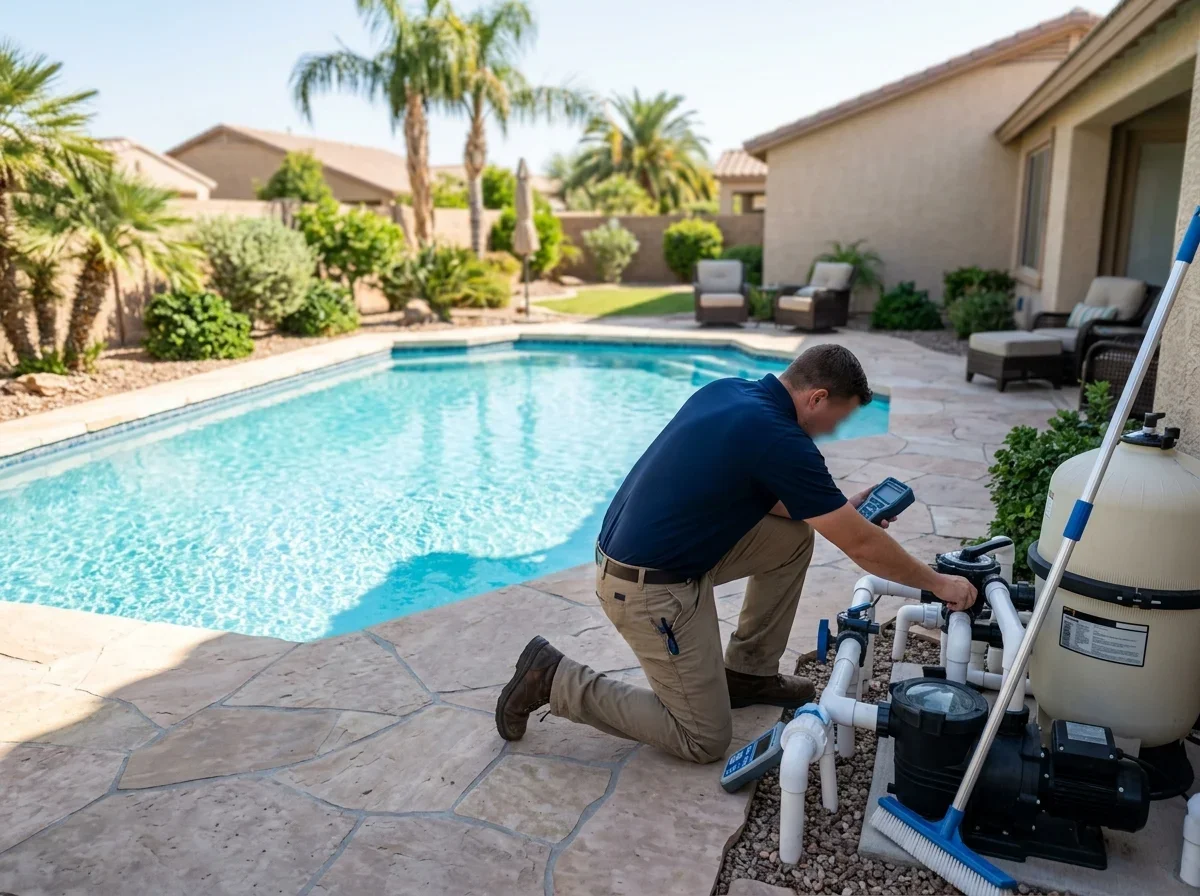
Routine equipment jobs fit comfortably. Pump replacement is the most likely one in the Phoenix area. Filter work and leak detection and repair fit as well.
Gas heaters are the gray area. Before you hire for heater repair, ask which license class covers the gas connection.
Jobs that call for a B-5 or KA-5 contractor
B-5 is the General Swimming Pool Contractor class. It covers construction and repair of pools and spas, code-required barriers, and utilities from the service point to the pool equipment. B-6 adds solar heating.[1][6] KA-5 combines the commercial A-9 and residential B-5 scopes, and KA-6 adds solar.
A full replaster, pebble finish or deck replacement falls outside R-6. That puts pool resurfacing and replastering and any remodel in B-class territory. For the finish itself, see plaster vs. pebble.
Barriers and fences
Fencing is B-5 territory too. State law generally bars openings that pass a four-inch sphere and requires self-closing, self-latching gates.[5] Local rules can be stricter.
Details are in our Arizona pool barrier law guide and the fence installation page.
How do you check a pool contractor's license with the ROC?
Use the ROC's online Contractor Search at roc.az.gov rather than trusting a truck door or a sales rep. Search by the exact legal business name or the license number.
- Status. It should read active. Suspended or revoked is a hard stop.
- Class. The class must cover the work in your contract. An R-6 holder quoting a full replaster is a red flag.[1][2]
- Bond and Recovery Fund. Look for current bond information and fund status.[3]
- Number match. The license number on your contract and in the ads must match the record. The business name must match the entity signing.
- Complaints. Read the complaint section instead of stopping at "active."
The ROC's Before You Hire page walks through the same checks.[2]
Step by step
Checking a license
Status
It should read active.
Class
The class must cover the work in your contract.
Bond and Recovery Fund
Look for current bond information and fund status.
Number match
The license number and business name must match the record.
Complaints
Read the complaint section instead of stopping at active.
Limits of the bond, Recovery Fund and insurance
Less than the sales pitch suggests.
License bond amounts depend on the contractor's classification and expected Arizona gross volume.[3] That bond is a limited pool of money, and it can be small next to a replaster or remodel.
Residential contractors also pay into the Residential Contractors' Recovery Fund or post a separate $200,000 surety or cash bond.[3] You have to pursue the license bond first and obtain a final determination. Then you submit records such as your original contract and proof of payment.[4]
How it works
How a Recovery Fund claim proceeds
Step 1: Pursue the license bond first
Step 2: Obtain a final determination
Step 3: Submit your original contract and proof of payment
The ROC states each residential license is covered up to $200,000, with a maximum of $30,000 per residential property owner, pro rata.[2]
The fund is a remedy after a violation is found, not insurance.
What "licensed, bonded and insured" does and doesn't prove
It proves very little on its own. It doesn't tell you the class fits your job, and it doesn't confirm general liability coverage, which the ROC doesn't require for licensing.
Ask for current certificates for workers' compensation and general liability, sent directly from the insurer. Our guide to whether that phrase is enough goes further.
Complaints against licensed contractors generally must be filed within two years for repair or remodel work. If the business that did the work was unlicensed, the ROC cannot offer the same complaint remedy.[2]
Contract terms required for work over $1,000
Under A.R.S. 32-1158, work over $1,000 needs a written contract with the license number, price, deposit and progress payments, and the ROC complaint notice. You should receive a copy, and cash payments need a receipt.[6]
The ROC advises against paying in cash or paying ahead of the work. Tie payments to visible milestones, and hold the last payment until inspections, startup and cleanup are done.
Pro tip
Tie each payment to a visible milestone and keep the final payment until inspections, startup and cleanup are done.
Permits are the owner's responsibility unless the contract says otherwise.[2] Name who pulls them. For Phoenix, see our Phoenix remodel permit guide.
Frequently asked questions
What are the experience requirements for getting a contractor license in Arizona?
The ROC sets them, and they vary by class. Check roc.az.gov for current rules.
Is it hard to get a contractor license in Arizona?
That is a question for the ROC's licensing pages. What matters for you is verifying the license a contractor already holds.
Do you need a permit to build a pool in Arizona?
Permits are set by the city. In Phoenix, see our permit guide for resurfacing and the remodel guide.
Does a pool cleaner need a contractor license in Arizona?
Cleaning alone is a service question. A.R.S. 32-1121 exempts only casual, minor work under $1,000 that needs no local permit and isn't split up to dodge the law. Ads must say "not a licensed contractor," and gas-connected work is excluded.[6]
How do I check if a pool contractor is licensed in Arizona?
Use the ROC Contractor Search and follow the five steps above.
Is a contractor who is licensed, bonded and insured fully covered?
No. Bond limits are finite, the Recovery Fund pays only after a final decision, and general liability isn't a licensing requirement.[3][4]
If you're hiring, the most useful next step is a list of questions to ask a pool contractor.
- Arizona Registrar of Contractors. "License Classifications." https://roc.az.gov/license-classifications. Accessed October 17, 2026.
- Arizona Registrar of Contractors. "Before You Hire a Contractor." https://roc.az.gov/before-hire. Accessed October 17, 2026.
- Arizona Registrar of Contractors. "Bond Information." https://roc.az.gov/bond-information. Accessed October 17, 2026.
- Arizona Registrar of Contractors. "Recovery Fund." https://roc.az.gov/recovery-fund. Accessed October 17, 2026.
- Arizona Legislature. "36-1681 — Pool Enclosures; Requirements; Exceptions." https://www.azleg.gov/ars/36/01681.htm. Accessed October 17, 2026.
- Arizona Registrar of Contractors. "Arizona Revised Statutes and Rules Book." https://roc.az.gov/sites/default/files/2024-09/2024%20Statute%20and%20Rules%20Book.pdf. Accessed October 17, 2026.