How do I know if my pool filter needs replacing or just cleaning?
Start with pressure. Pentair says a gauge reading 8 to 10 psi above the clean-start pressure means the filter is clogged and needs cleaning.[2] Weak return flow, short stretches between cleanings and cloudy water despite balanced chemistry point the same way.
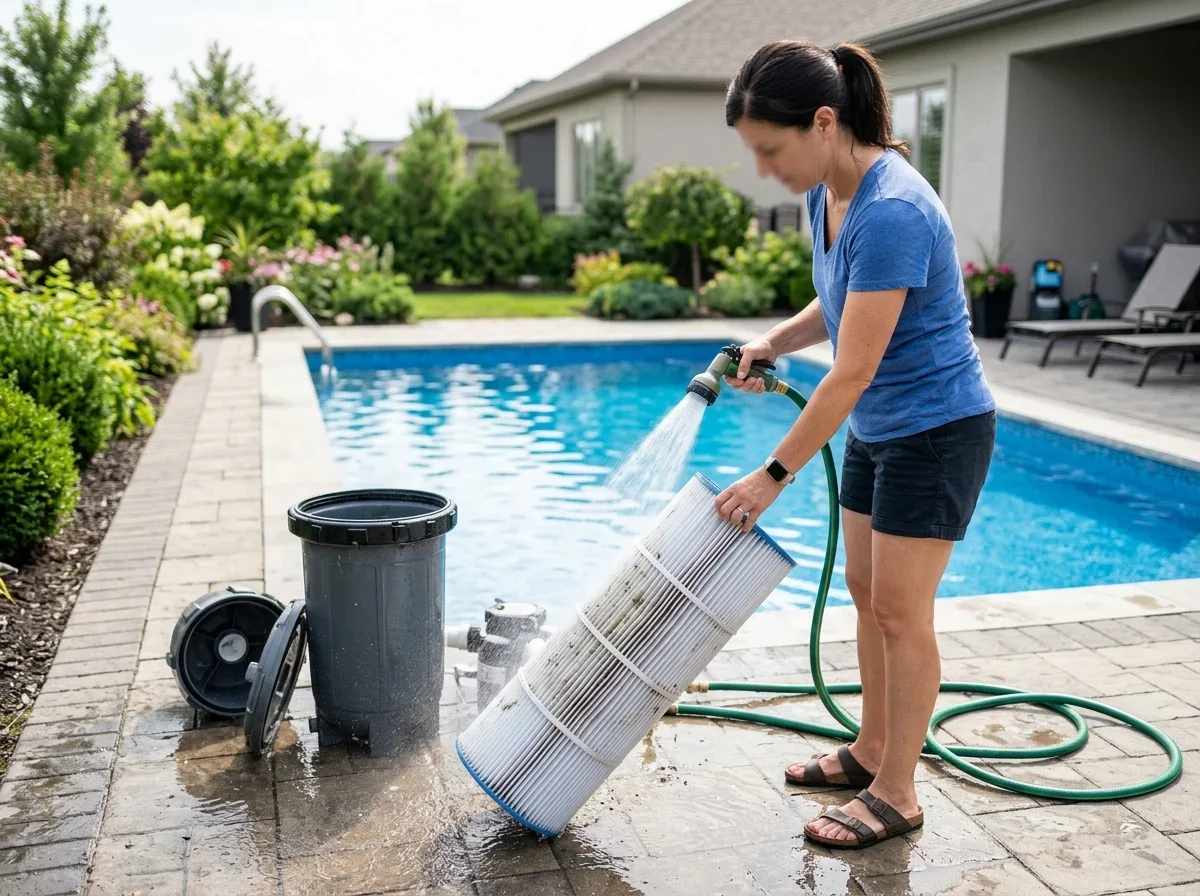
Cleaning comes first, and you can do it as a quick test:
- Note the pressure right after your last proper cleaning. That's your baseline.
- Backwash a sand filter, or hose off the cartridges one pleat at a time.
- Recheck the gauge and write the new number down.
- If pressure climbs back fast, or the media is visibly damaged, move on to replacement.
If pressure is normal and the media looks intact, check chemistry, algae and circulation first. Our guide to cloudy pool water causes covers the non-filter culprits.
Side by side
Clean or replace?
Clean first
- Pressure is high but media looks intact
- Hose off cartridges or backwash sand
- Recheck against your baseline
Replace
- Pressure climbs back fast
- Media is visibly damaged
- Pleats are torn or flattened
| Likely symptom | Filter type affected | Usual fix | Replace media or the whole unit? |
|---|---|---|---|
| High pressure after cleaning | Cartridge and sand | Clean again, then check the gauge and inspect the media | Media if it is damaged or loads up again quickly; otherwise neither |
| Cloudy water after backwash | Mostly sand | Check chemistry first, then look for channeling or worn sand | Fresh sand if the bed is worn; the whole unit only if laterals or the tank are damaged |
| Torn or flattened pleats | Cartridge | Replace the cartridge set | Media only |
| Cracked tank or leaking clamp | Both | Repair or replace the housing, clamp or lid seal | Whole unit or housing; new media won't help |
| Stuck or fogged pressure gauge | Both | Replace the gauge and recheck against your baseline | Neither, unless the gauge was hiding a real problem |
Signs a cartridge pool filter has reached end of life
Look at the cartridge itself. Torn or flattened pleats, cracked end caps, and media that feels stiff or crumbly all mean it's finished. So does pressure that stays high after a thorough hose-down.
Pentair's service procedure is to remove the cartridge, wash it with a garden hose, and replace it if cleaning doesn't restore flow.[1] Persistent problems after service call for stopping the pump and getting technical help.[3]
Manufacturers tie cartridge life to use and condition rather than a fixed calendar interval.
Phoenix pools are a harder test than most. Summer heat, dust and long pump run times load pleats quickly, so inspect them more often from June through August.
Pro tip
Write down your clean-start pressure after each proper cleaning. A number on paper makes it easy to tell a clogged cartridge from a tired one.
If flow is still weak after cleaning, check the skimmer and pump baskets. When those are clear, the pump may be the problem. See pool pump repair and replacement if that sounds familiar.[4]
Choosing the right replacement cartridge
Match the model number printed on the tank or on the old cartridge. Then check the dimensions and the square-foot rating, because a near-fit cartridge can leave gaps that let debris bypass the pleats. Style matters too: A and C designations refer to specific cartridge forms, so confirm yours against the manufacturer's spec.
Where the filter holds several cartridges, replace the full set together.
Pentair's procedure for multi-cartridge filters calls for removing each cartridge separately and installing the complete replacement set on the support pipes before reinstalling the manifold.[6] Mixing old and new leaves the weakest cartridge setting your flow.
Signs a sand filter needs fresh sand
Sand wears out quietly. Watch for channeling (water cutting paths through the bed instead of filtering evenly), water that returns cloudy after backwash, and backwashing that's needed constantly. Sand that clumps or feels smooth like glass is another sign.
Pentair doesn't treat sand as an automatic yearly swap. Its manual focuses on backwashing, using a filter-cleaning solution, and refilling with the exact amount shown on the nameplate.[5]
The job itself runs in a predictable order:
- Shut off power and relieve all pressure.
- Drain the tank and remove the old sand.
- Inspect the laterals for cracks.
- Refill with the specified amount of No. 20 silica sand, about 0.018 to 0.022 inches in particle size.[5]
If the laterals or the tank are damaged, fresh sand won't hold up for long. At that point a new filter starts to make more sense than another round of media.
Step by step
Replacing sand in order
Power off
Shut off power and relieve all pressure.
Drain and empty
Drain the tank and remove the old sand.
Inspect laterals
Check the laterals for cracks.
Refill
Add the specified amount of No. 20 silica sand.
Housing and gauge faults that new media will not fix
Some filter problems have nothing to do with what's inside the tank. A cracked housing, a leaking clamp or lid, a warped multiport valve and leaks at the base all call for hardware, not media.
Many Phoenix-area homes date to the mid-1980s, so original housings and valves are often decades old. That's a reason to inspect them, not proof they've failed.
The gauge deserves a look before anything else. A stuck needle, fogged glass or a reading that never changes can mimic a clogged filter. If the gauge doesn't return near your recorded clean baseline, replace it and recheck. It's usually the cheapest fix on this page.
After any service, watch for new leaks. A dry, stretched or poorly seated O-ring is a common reason a lid weeps after you close it back up.
How the parts connect
Hardware to check besides the media
Housing
Look for cracks and base leaks
Clamp or lid
O-ring
Dry, stretched or poorly seated
Multiport valve
Warping
Pressure gauge
Compare with your baseline
If the tank, valve or leaks are the problem, new media won't help. For a hands-on diagnosis, see pool filter repair and replacement.
Pool filter replacement costs
Cost depends on what needs replacing. The main drivers are:
- Media only (sand or a cartridge set) versus a complete filter
- Housing, valve or gauge work
- Plumbing changes if the new unit doesn't line up with the old
- Labor, disposal and the equipment brand
Phoenix-area pool companies' own websites, checked October 2026, show diagnostic or service-call fees that most often run $85 to $95. One company lists equipment repair at $80 per hour plus parts, with a 30-minute minimum. Those figures cover diagnosis and small repairs, not a full filter swap.
For a replacement, get a written itemized quote that separates media, filter or housing, gauge and labor. Ask whether it covers disposal and warranty too.
Arizona contracts over $1,000 must be in writing under A.R.S. 32-1158, including the license number and payment terms. For a local number, request a quote through the pool filter service page.
Key takeaways
- Service-call fees most often run $85 to $95
- Equipment repair of $80 per hour has a 30-minute minimum at one company
- Ask for a written quote that separates media, filter or housing, gauge and labor
- Arizona contracts over $1,000 must be in writing
Arizona licensing for pool filter replacement work
You can swap your own media. For hired work, the Arizona Registrar of Contractors (ROC) lists the R-6 or CR-6 classification for pool service and minor repair, and B-5 or KA-5 for broader pool work. Our guide to Arizona pool license classes explains the differences.
A whole-filter swap that touches plumbing or electrical may need more than a basic service license. Confirm the contractor's active class covers your specific job.
Before you hire, run through this checklist on the ROC Contractor Search:
- License is active and the class fits the work
- Bond and Recovery Fund status
- Workers' compensation certificate (an ad saying "licensed, bonded and insured" proves nothing)
- Written itemized quote
- Who pulls the permit, stated in the contract
The ROC says eligible owners can claim up to $30,000 from the Residential Contractors' Recovery Fund after a final decision against a licensed contractor. Hire an unlicensed person and you have no recourse through the ROC.
Permits are a separate question. Ask your city whether an equipment swap needs one. Scottsdale's pool permit application asks for the contractor's ROC number, and Mesa lists a contractor licensure verification form for pool permits.
Pool filter replacement FAQ
How often should a pool cartridge filter be replaced?
There's no single interval. Clean on pressure, inspect the pleats, and replace when they're damaged or won't clean up.[1] Phoenix summers can shorten the gap between cleanings.
How do I know what pool filter cartridge to buy?
Match the model number on the tank or old cartridge, then confirm the dimensions and square-foot rating. Replace the full set together on multi-cartridge filters.[6]
How much does a cartridge pool filter typically cost?
It depends on the brand, size and whether you're buying media or a complete filter. Get an itemized written quote and ask what each line covers.
How long does a cartridge last in a pool filter?
Lifespan varies with use, debris load and how carefully you clean. Physical condition is the better guide than age.
How much does a pool filter cost?
A full filter costs more than media alone, and installation adds labor and possibly plumbing changes. Compare quotes line by line.
Can a cloudy pool be caused by an old filter?
Yes, but only sometimes. If pressure is normal and the media is intact, look at chemistry, algae and circulation first. If the pleats are torn or the sand is worn, the filter may be the cause.
- Pentair. "Clean and Clear RP Cartridge Filter Manual." https://www.pentair.com/content/dam/extranet/nam/pentair-pool/residential/filters/clean-and-clear-family/clean-clear-rp-filter/manual/clean-clear-rp-cartridge-filter-manual-english.pdf. Accessed October 17, 2026.
- Pentair. "Clean and Clear Product Support." https://www.pentair.com/en-us/pool-spa/education-support/homeowner-support/pool-filter-product-safety-help-center/clean-clear-product-support.html. Accessed October 17, 2026.
- Pentair. "Clean and Clear Plus Cartridge Filter Cleaning Guide." https://www.pentair.com/content/dam/extranet/nam/pentair-pool/residential/filters/clean-and-clear-family/clean-and-clear-plus/clean-and-clear-plus-guides-manuals/clean-and-clear-plus-cleaning-guide.pdf. Accessed October 17, 2026.
- Pentair. "Clean and Clear Plus Cartridge Filters." https://www.pentair.com/en-us/pool-spa/products/filters/clean-and-clear-plus-cartridge-filters.html. Accessed October 17, 2026.
- Pentair. "Sand Dollar and Cristal-Flo II Top Mount Sand Filter Manual." https://www.pentair.com/content/dam/extranet/nam/pentair-pool/pool-manuals/filters/Sand_Filter_Installation_and_Users_Guide_English_Spanish_French.pdf. Accessed October 17, 2026.
- Pentair. "FullFloXF C-Series Cartridge Filter Manual." https://www.pentair.com/content/dam/extranet/nam/pentair-pool/residential/filters/fullflo-xf/fullfloxf-manuals/c-series/ffxf-c-manual.pdf. Accessed October 17, 2026.