What makes pool water cloudy?
Cloudy water is fine particles or dissolved minerals that your filter is not removing. The causes fall into four groups, listed here from easiest to hardest to fix: chemistry, filtration, calcium, and early algae.
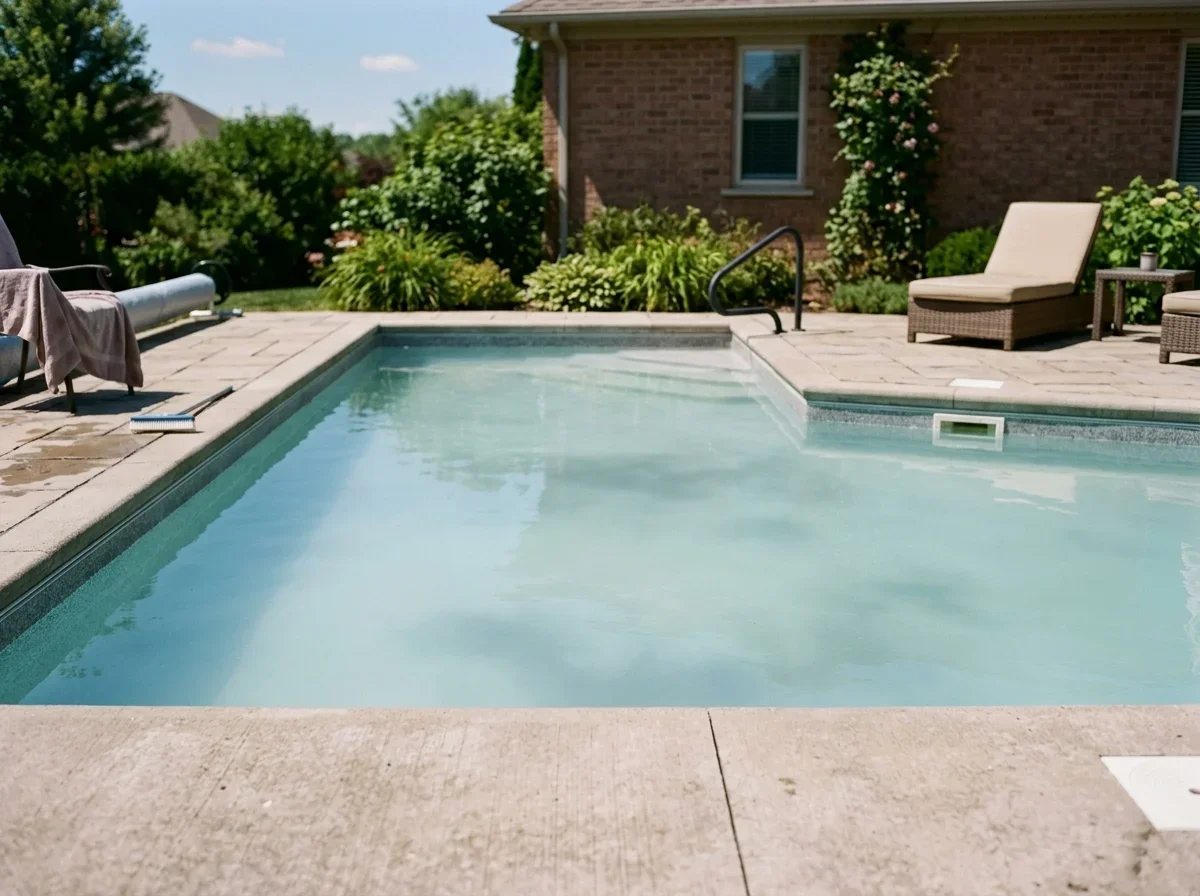
Run the checks in this order: test the water, check pump runtime and flow, check the filter, then consider calcium.
If the water has a green tint, head to yellow-green algae in your pool.
| Likely cause | How to spot it | First fix | Pro needed when |
|---|---|---|---|
| Unbalanced chemistry | Test readings outside range | Adjust one item, then retest | Readings will not hold |
| Low sanitizer or high pH | Dull haze, weak chlorine reading | Correct pH, restore chlorine | Chlorine keeps disappearing |
| Filter or pump problem | Weak return flow, high gauge pressure | Clean baskets and filter, run longer | Unit is failing or worn out |
| Calcium or hard water | White haze that returns, scale at waterline | Test hardness in pool and fill water | Levels are very high |
| Early algae | Recent green water or recent shock | Brush, vacuum, keep filtering | Water turns green |
Water chemistry as a cause of cloudiness
Test before you add anything. A drop-based kit gives more reliable readings than strips, and if you do not own one, a pool shop can test a water sample for you. Check free chlorine, pH, and alkalinity at minimum.
The CDC recommends pH of 7.0 to 7.8 and free chlorine of at least 1 ppm, or at least 2 ppm when cyanuric acid is in the water.[1] PHTA guidance lists a pH target of 7.2 to 7.6 for balancing.[5]
As pH climbs, chlorine becomes less effective, especially above 8.0.[1] Weak sanitizer lets fine contaminants linger, and the water goes dull.
Change one thing at a time. Circulate, then retest.
Pro tip
Record every reading before you add anything, so you can see which single change moved the water.
Cloudiness after adding chlorine or shock
A heavy dose can briefly haze the water as it breaks down contaminants, and the filter then has to catch what is left. Shock is not a cure-all. If pH, alkalinity, or filtration is the real problem, more shock will not fix it.
Repeated shock can also raise pH and calcium, which is a particular risk in hard-water areas. Test pH and calcium before adding more product.
Keep the pump running.
Filter and pump faults that leave water cloudy
Water only gets clean when it moves through the filter. A pump that runs too few hours, a full skimmer basket, or a closed valve leaves water uncleaned. PHTA notes that continuous pump and filter operation is required during plaster start-up until cloudiness is gone, which shows how much sustained filtration matters for suspended particles.[4]
Confirm the pump is primed, returns are pushing water, and baskets are empty. Then look at the filter itself. Note the clean starting pressure on the gauge, and clean or backwash when pressure rises well above it.
How the parts connect
Where water must flow to get clean
Skimmer basket
Keep it empty
Pump
Primed and running
Filter
Watch the gauge pressure
Returns
Should push water
Worn sand or a torn cartridge can pass fine particles straight back into the pool. If your media is old, the pool filter replacement guide explains when to swap sand or cartridges.
For a failing unit, see pool filter repair and replacement or pool pump repair and replacement.
Calcium's role in cloudy Phoenix pool water
In Phoenix, this is not an optional check. Arizona fill water is very hard, and evaporation leaves minerals behind while each top-off adds more.
PHTA's fact sheet, citing ANSI/APSP-11, treats calcium hardness of 150 to 1,000 ppm as acceptable for pools.[3] High hardness can be offset by lowering pH and alkalinity within acceptable ranges, though reducing hardness itself may require draining and replacing some water.[3]
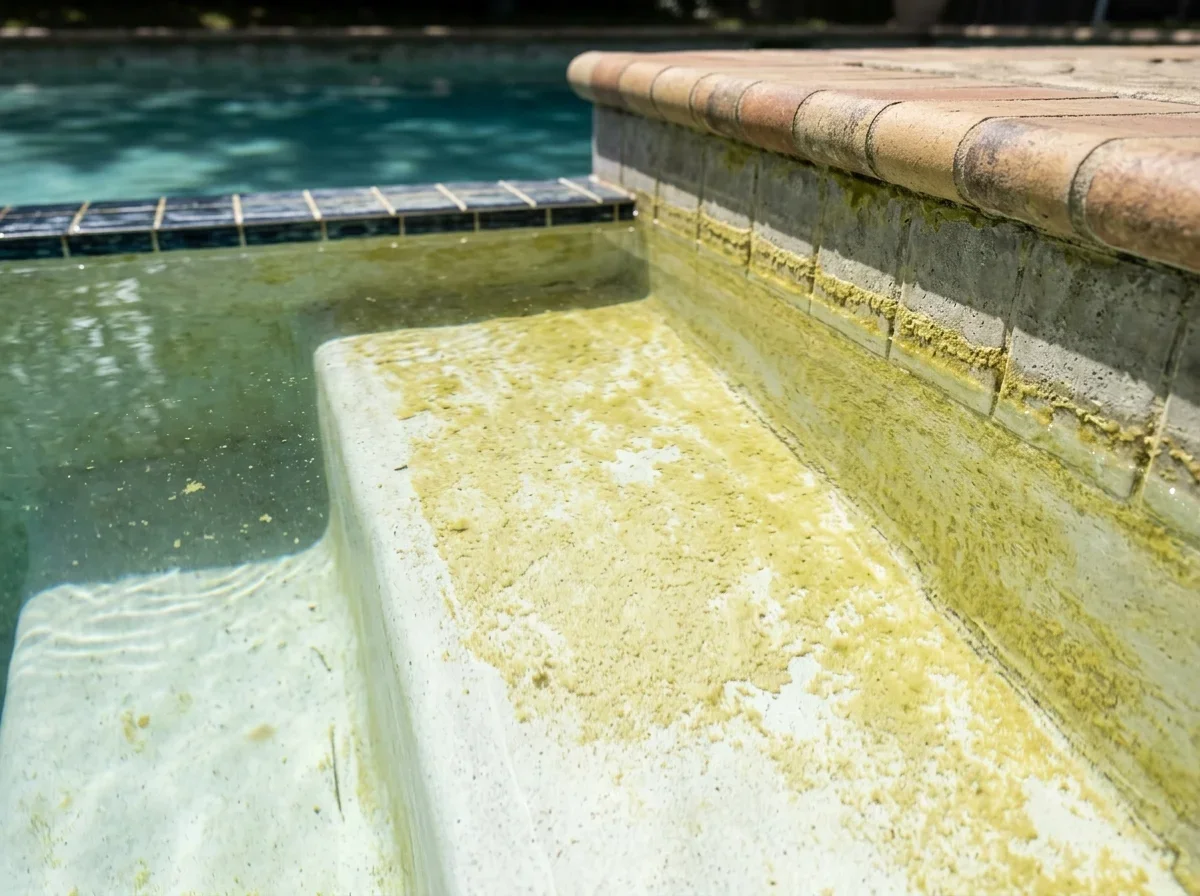
The tell is white haze that comes back after the pool clears, plus scale on the tile line or waterline. Calcium does not "balance away" with more chemicals.
See white crust on pool tile and pool tile repair and calcium removal for the visible side of the problem.
Where hardness exceeds 1,000 ppm, PHTA recommends finding a lower-mineral water source.[2] Partial draining or other treatment at that level is a pro decision.
Steps for clearing a cloudy pool fast
Quick clearing comes from doing the earlier checks well, not from one big dose. Follow this order:
- Test and balance the water, adjusting one item at a time.
- Run the pump continuously.
- Clean the filter, and keep cleaning it as it loads with fines.
- Brush the walls and floor, then vacuum so particles reach the filter.
- Retest and repeat.
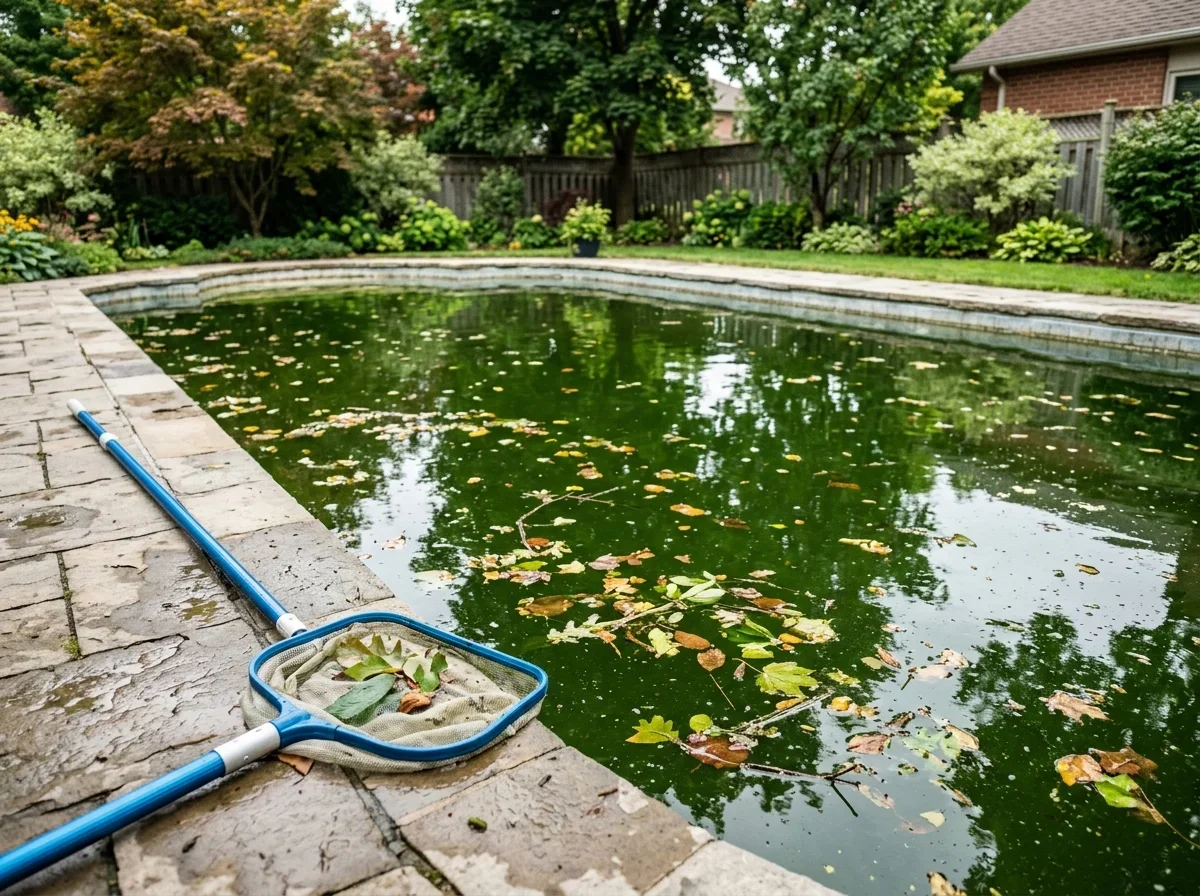
If the pool was green recently or was just shocked, the haze is probably dead algae. It has to be brushed up and caught by the filter.
How it works
How dead algae haze clears
Step 1: Brush walls and floor
Lifts particles into the water
Step 2: Vacuum the pool
Moves particles toward the filter
Step 3: Filter catches fines
Clean it as it loads
Step 4: Retest and repeat
A clarifier or flocculant can help as an optional aid. Clarifiers clump fine particles so the filter can catch them, while flocculants sink them for vacuuming. Follow the product label.
Swimming in a cloudy pool
No.
Cloudy water hides a swimmer in trouble on the bottom, and low sanitizer may be the reason it is cloudy. Keep swimmers out until the water tests right and you can clearly see the floor.
When a pro is needed
Call when any of these happens:
- The water stays cloudy after the chemistry and filter checks.
- The water turns green.
- Equipment looks failed, or calcium is very high.
For Phoenix, Mesa, Scottsdale, Tempe, Chandler, and Gilbert homes, green pool cleanup and water treatment covers the hard cases. One Phoenix company's site lists pool recovery for a standard residential pool at $300-$600, based on Phoenix-area pool companies' own websites, checked October 2026. Get an itemized written quote.
In Arizona, pool service and minor repair fall under Registrar of Contractors (ROC) classes R-6 or CR-6, with broader work under B-5 or KA-5. Check the class, bond, and Recovery Fund status on the ROC Contractor Search at roc.az.gov/before-hire.
If a job grows past $1,000, Arizona requires a written contract that includes the license number.
Key takeaways
- Test the water and fix one item at a time
- Keep the pump running and the filter clean
- Calcium haze needs a hardness test, not more shock
- Call a pro if the water turns green
- Get an itemized written quote
More detail is in R-6, B-5 or KA-5: which license fits.
Cloudy pool water FAQ
How to clear up a cloudy pool quickly?
Balance the water, run the pump continuously, clean the filter, brush and vacuum, then retest. Speed depends on fixing the actual cause, so skip repeated shock.
How do I use a pool test kit?
Test before you add anything and record every reading. Change one variable, circulate, and retest.
Why is my pool water cloudy after adding chlorine?
A heavy dose can briefly cloud water as it reacts with contaminants, and the filter has to catch what remains.
Is it okay to swim in a cloudy pool?
No. You cannot see the bottom, and sanitizer may be low.
Why is my pool still cloudy after shocking?
Shock does not fix poor filtration, high pH, or calcium. Dead algae also has to be filtered out, so keep brushing and cleaning the filter.
Does a pool clarifier work?
It can help the filter catch fine particles, but it is an aid, not a cure.
This applies to saltwater and above-ground pools too, though a chlorine vs. salt water comparison covers the differences.
Questions
- Centers for Disease Control and Prevention. "Home Pool and Hot Tub Water Treatment and Testing." https://www.cdc.gov/healthy-swimming/about/home-pool-and-hot-tub-water-treatment-and-testing.html. Accessed October 17, 2026.
- Pool & Hot Tub Alliance. "Source Water and Its Effects on Pool and Spa Maintenance." https://www.phta.org/pub/?id=53d1e73e-1866-daac-99fb-f876911f3abb. Accessed October 17, 2026.
- Pool & Hot Tub Alliance. "PHTA Fact Sheet." https://www.phta.org/pub/?id=50ffe77d-1866-daac-99fb-9719108d1367. Accessed October 17, 2026.
- Pool & Hot Tub Alliance. "Start-Up for Plastered Pools." https://www.phta.org/pub/?id=9d96a292-1866-daac-99fb-37b968a3f382. Accessed October 17, 2026.
- Pool & Hot Tub Alliance. "Introduction." https://www.phta.org/pub/?id=33925d23-1866-daac-99fb-dbf23704fd63. Accessed October 17, 2026.