Telling evaporation apart from a pool leak
Some water loss is normal. Evaporation depends on temperature, wind exposure and bather load, so it varies by location and season.[3] In hot, low-humidity climates, a residential pool may lose up to 1 inch of water per week through evaporation.[4]
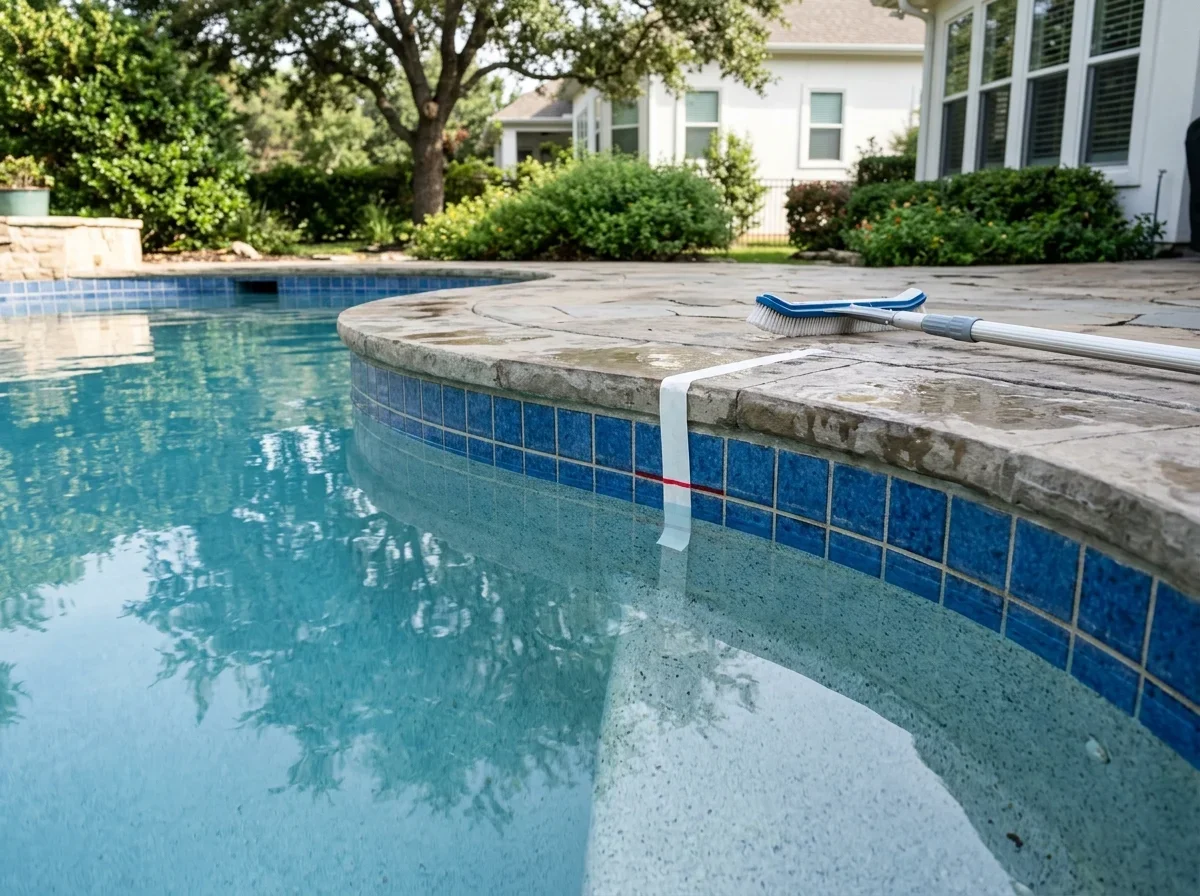
Two inches in a week is more than that general figure, so it deserves a closer look.
A general industry rule of thumb treats about 1/4 inch per day as a threshold that may warrant investigation, though evaporation varies with conditions.[2]
Signs that point toward a leak rather than evaporation:
- An autofill that seems to run constantly
- Wet soil or standing water near the equipment pad
- Visible cracks in the shell or tile line
- Air bubbles in the pump basket or at the returns
- Water loss that continues with the pump off
Bucket test steps for a pool
The bucket test is free, uses household items and is the quickest way to separate evaporation from a real leak. It compares water loss in your pool with water loss in a bucket sitting in the same sun and wind.[3]
Step by step
- Turn off the autofill and skip the test if rain is forecast.
- Fill a bucket with pool water until the inside level matches the pool level.
- Set the bucket on a submerged step so it is stable and partly underwater.
- Mark the water level on the inside of the bucket and on the outside, at the pool's waterline.
- Leave the pump on its normal schedule and note that it is running.
- Compare both marks after 24 to 48 hours.[1]
Evaporation hits both equally, so only a real leak widens the gap between them.
How it works
How the bucket test works
Step 1: Bucket set on a submerged step
Inside level matches the pool level
Step 2: Mark both water levels
Inside the bucket and outside at the waterline
Step 3: Wait 24 to 48 hours
Pump on its normal schedule
Step 4: Compare the two drops
A bigger pool drop points to a leak
Reading the result
If the pool and the bucket drop by about the same amount, evaporation is the likely explanation. If the pool loses more water than the bucket, evaporation alone does not explain it.[1]
One run isn't always enough. Repeat the test with the pump off, then with it running under normal conditions.
| Result | What it suggests |
|---|---|
| Pool and bucket drop the same | Evaporation is likely |
| Pool drops more, pump on only | Possible pressure-side plumbing |
| Pool drops more, pump off only | Possible suction side or shell |
| Pool drops more both ways | Leak likely, location unclear |
Treat these as hints, not diagnoses. The bucket test says leak or no leak. It does not say where.
Pro tip
Run the bucket test twice, once with the pump off and once with it running, and write down both results. The difference helps narrow down where the leak may be.
Using dye to find a pool leak
Once the bucket test points to a leak, a dye test can help you find an accessible one. Shut the pump off and let the water go completely still. Then release a small amount of dye near suspect spots and watch whether it drifts toward a single point.[1]
Dye kit vs food coloring
A pool leak detection dye kit usually comes with a syringe or dropper that lets you place a small, controlled amount of dye right at a crack or fitting.
Food coloring is a common shortcut. If you try it, use very small amounts.
Where to look
Check the places where water is most likely to escape:
- Cracks in the shell or plaster
- Fitting edges at returns and skimmer throats
- Light niches and conduit entries[3]
- Drains and seams in the tile line
If dye is drawn into a crack, fitting or drain, water is moving toward the leak. For crack causes and repair timing, see Cracks in Your Pool: Causes and When to Repair.
Dye only finds accessible, visible leaks and will not reveal a buried plumbing leak.
Common sources of pool leaks
Leaks tend to start where something passes through the pool wall or connects to another component. The usual suspects are shell cracks, skimmer and return fittings, light niches, the tile line, pump and filter connections, and underground plumbing.[4]
Visible dripping or crusty mineral deposits at the equipment pad point to a pump, filter or heater connection. Soggy ground away from the pad, or decking that is sinking, suggests a buried line.
Buried leaks matter because of Phoenix soil. Caliche hardpan sits 1 to 6 feet down and can make trenching 2 to 3 times costlier than normal soil. Pinpointing the leak before anyone digs saves real money.
Depth
Where caliche hardpan sits below the surface
Ground level
- 1 feetCaliche can start
- 6 feetCaliche can reach
When to bring in a pool leak detection pro
Call when the bucket test fails and dye finds nothing, when the loss is large, or when you suspect the leak is underground or in the structure. Continuing to add water hides the true rate of loss.
Professionals add pressure testing and specialized locating equipment that homeowners don't have.[2] Check the contractor before you pay for detection or repair:
- Confirm an active license on the ROC Contractor Search at roc.az.gov/before-hire. Pool service and minor repair fall under R-6 or CR-6, while broader work falls under B-5 or KA-5. Check the record for bond and Recovery Fund status.
- Get a written contract for anything over $1,000. Under A.R.S. 32-1158, it must include the license number, price, payment terms and the ROC complaint notice.
- Ask for proof of workers' compensation. "Licensed, bonded and insured" in an ad does not prove coverage.
- Pay carefully. Avoid cash, and don't let payments run ahead of the work.
- Get the scope in writing. Confirm what detection includes and whether repair is priced separately.
The ROC says owners who hire an unlicensed business have no ROC recourse. For more on classes, see R-6, B-5 or KA-5: Which Arizona Pool License Fits Your Job?.
Checklist
Before you hire a leak detection pro
0 of 5 ticked
Tick them off as you go. Nothing is saved or sent.
Permit rules for leak repair differ by city, so ask your city's building department before work starts. When you're ready, see pool leak detection and repair.
Frequently asked questions
Is it normal to lose 2 inches of water out of a pool?
It depends on the timeframe. In hot, dry climates a pool may lose up to 1 inch per week to evaporation,[4] so 2 inches in a week is worth testing.
Can I use food coloring to find a pool leak?
Possibly, but a dedicated dye kit lets you place a small, controlled amount exactly where you need it. Use dye with the pump off and the water still.
How do I use the bucket method on my pool?
Match the water level inside a bucket on a step to the pool level, mark both, and compare after 24 to 48 hours.[1]
Does a pool leak detection kit work?
For visible cracks and fittings, yes, when the water is calm. It will not find buried plumbing leaks.
How much does pool leak detection cost?
Quotes vary with the pool, the suspected leak location and how hard it is to reach. Ask for an itemized written quote that separates detection from repair.
How much does pool leak repair cost?
Repair cost depends on what failed and where. A leaking fitting at the pad is a different job than a buried line under caliche.
One Phoenix company's site lists pool equipment repair at $80/Hour plus parts, with a 30 minute minimum, while another says swimming pool repairs run $100 to $20,000. Those are general guidance, not quotes, so get your own in writing.
Questions
- Pool Industry Show. "Pool Leak Detection Services: Techniques and Providers." https://poolindustryshow.com/pool-leak-detection-services. Accessed October 17, 2026.
- Pool Tech Resources. "Pool Leak Detection Methods and Tools Overview." https://pooltechresources.com/pool-leak-detection-methods-and-tools/. Accessed October 17, 2026.
- National Pool Service Authority. "Pool Leak Detection Services: Methods and When to Call a Pro." https://nationalpoolserviceauthority.com/pool-leak-detection-services/. Accessed October 17, 2026.
- Home Pool Network. "Pool Leak Detection Services: How Professionals Find and Diagnose Leaks." https://homepoolnetwork.com/pool-leak-detection-services/. Accessed October 17, 2026.