Crack types that appear in plaster-over-concrete pools
This page covers plaster-over-concrete pools, the type most common in Phoenix, Mesa and Scottsdale. Fiberglass and vinyl shells crack differently and need different repairs, so they are outside what follows.
Hairline surface cracks
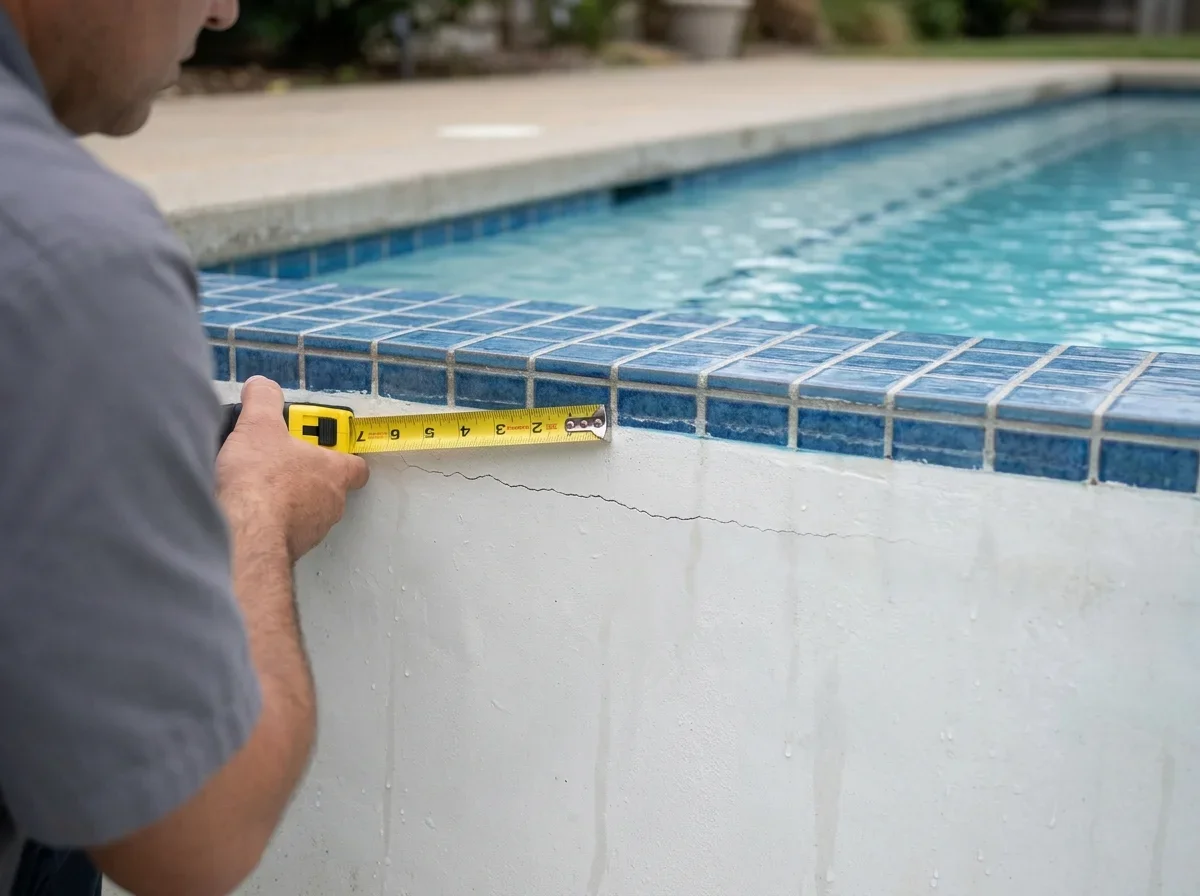
Surface cracks sit in the plaster or finish layer only. They look like fine, shallow lines or a spiderweb pattern, and they are often cosmetic.
Manufacturers who sell concrete pool repair products tell owners to inspect a crack's depth, width and location before choosing any fix.[5]
Structural cracks
Structural cracks go through the shell, not just the finish. They tend to be wider, and the two faces of the crack may sit at different heights.
Indicators include penetration beyond the plaster layer, measurable water loss, movement between the crack faces, subsidence, deck heaving or shell deformation.[6]
| Surface (hairline) crack | Structural crack | |
|---|---|---|
| Typical look | Fine line or web pattern, flat to the touch | Wider line, possibly a ledge you can feel |
| Depth | Finish layer only | Through the shell |
| Does it grow? | Usually stable | May widen or lengthen over weeks |
| Likely leak link | Low, but check anyway | Higher, especially below the waterline |
| Usual response | Monitor, patch, or plan a resurface | Find the cause, repair the shell, then refinish |
| Who to call | Pool service or repair contractor | Licensed repair contractor, possibly an engineer |
Ground movement, construction and finish age as crack causes
Cracks usually trace back to one of three things: ground movement, how the shell was built, or the age of the finish.
Poor soil support under the shell lets it shift or settle, and a shell that moves will crack. Manufacturers of structural repair systems note that stapling and injection address cracks in concrete, gunite and shotcrete shells, but they do not remove the cause.[4]
Draining a pool can also put stress on the shell, so ask a pro before you empty one.
Surface cracks are different. Fine crazing in the finish is more often a finish problem than a shell problem, and many Phoenix-metro pools are decades old.
If the whole finish is worn, pool resurfacing and replastering may be a better use of money than patching one line.
Signs that a pool crack is structural
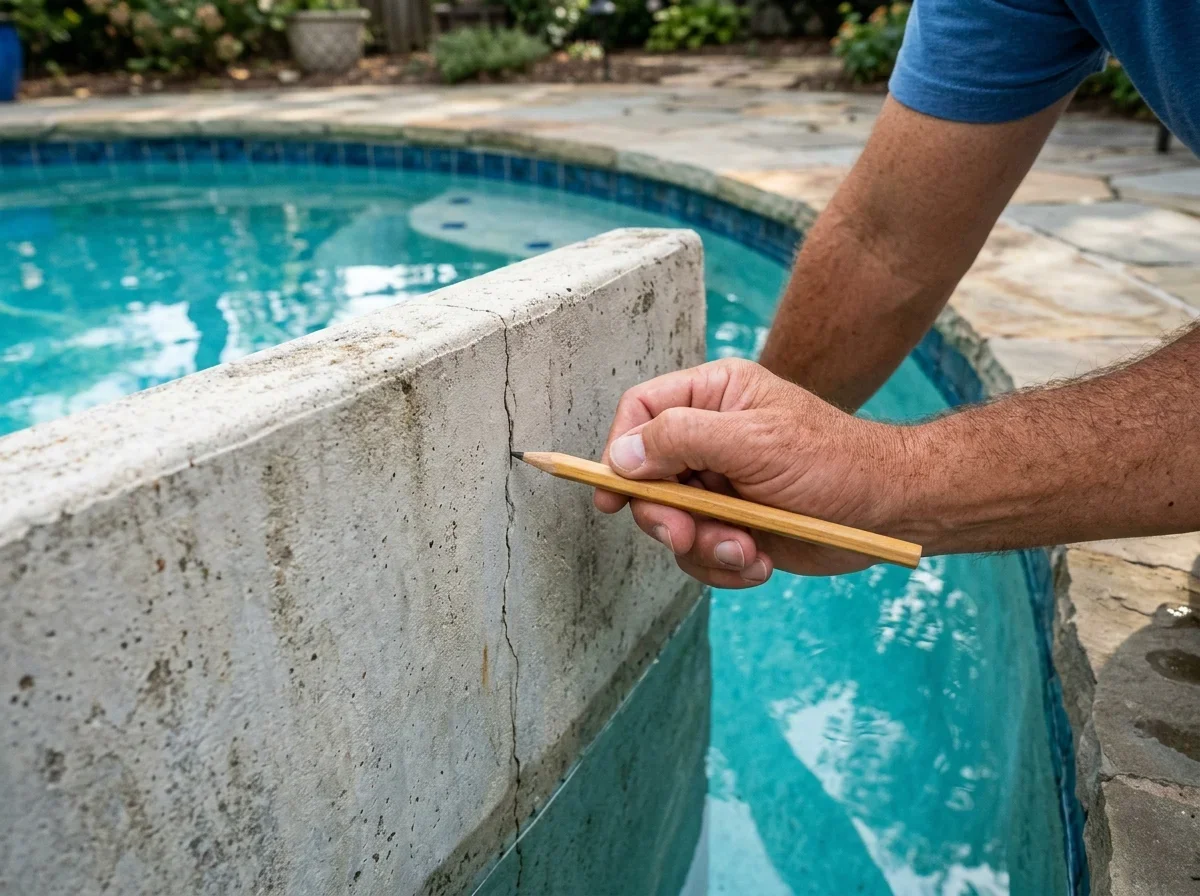
Photograph the crack, note its width and length, and mark the ends with a pencil so you can tell later whether it has grown.
A short checklist helps:
- Can you feel a ledge where the two edges meet?
- Does the crack continue through the tile and coping into the deck?
- Has it lengthened or widened over several weeks?
- Is there staining or wet ground nearby?
- Is the crack below the waterline, and does the water level drop near it?
A crack that follows a deck crack, shows an offset edge, or sits under water with a dropping water level points toward the shell. Those are reasons to call a pro.
How serious is it
Level 1 of 2: Likely cosmetic
Signs Fine line or web pattern, flat to the touch, not growing
What to do Monitor, patch, or plan a resurface
Level 2 of 2: Likely structural
Signs Offset edge, crack continuing into the deck, or water loss near it
What to do Call a licensed contractor or engineer
A licensed contractor or engineer confirms the diagnosis, and a visual check alone should not pick your repair product.
Repair options for pool cracks and timing
Yes, most can. What differs is the scope.
For a stable hairline crack, monitor it first. If it holds, a patch may be enough, or you can fold it into a future resurface.
Structural cracks need the cause addressed as well as the crack. Manufacturers describe structural staples and epoxy-based injection or anchoring systems for concrete, gunite and shotcrete pools, and they reserve those methods for deeper cracks.[4][5] The usual sequence is to find the cause, repair the shell, waterproof, then replaster or refinish.
How it works
Usual sequence for a structural crack
Step 1: Find the cause
Step 2: Repair the shell
Step 3: Waterproof
Step 4: Replaster or refinish
DIY kits (epoxy, hydraulic cement) suit minor, stable cracks. On a crack that is still moving, a rigid patch can reopen, and it can hide a problem that needs a pro.
Pro tip
Mark the crack ends and check them over several weeks before patching. A crack that has not moved is a far safer candidate for a DIY kit.
Cost depends on crack type, cause and access. Phoenix-area pool companies' own websites, checked October 2026, list diagnostic or service-call fees that most often run $85 to $95. One Phoenix company's site says swimming pool repairs run $100 to $20,000 overall.
Get an itemized written quote through pool repair for your specific crack.
Cracks and leaks are separate problems in a pool
Not necessarily. A crack can be a leak path, but not every crack leaks, and not every leak is a crack. Skimmer seals, plumbing connections and other fittings can lose water while a harmless crack gets the blame.
A bucket test helps separate evaporation from a real leak, and manufacturers recommend it for that purpose.[5] Our guide on why your pool is losing water walks through the checks.
When the water loss is real and the source is unclear, a specialist can trace it. That is the job of pool leak detection and repair, and it should happen before you buy any patch material.
Arizona licensing for pool crack repair (ROC R-6 and CR-6)
Pool work in Arizona is licensed work under the Arizona Registrar of Contractors (ROC). The R-6 classification covers residential pool service and minor repair, and CR-6 covers combined commercial and residential scopes.[1][2][3]
The class matters because R-6 does not cover complete replacement of plaster or pebble interiors. A crack job that grows into a full replaster can call for a different license. Our guide to Arizona pool license classes explains the differences.
Before you hire:
- Check the license on the ROC Contractor Search and confirm it is active.
- Confirm the class covers the work in the contract.
- Check bond and Recovery Fund status at roc.az.gov/before-hire.
- Get a written contract with the license number if the job exceeds $1,000.
Ask who pulls any needed permit and put the answer in the contract, because permits are the owner's responsibility unless the contract says otherwise.
Checklist
Before you hire a pool crack contractor
0 of 5 ticked
Tick them off as you go. Nothing is saved or sent.
Frequently asked questions about pool cracks
Can a crack in a pool be repaired?
Yes. Stable hairline cracks can be monitored, patched or resurfaced. Structural cracks need shell repair, such as epoxy injection or structural staples, plus attention to the cause.[4]
How to tell if a pool crack is structural?
Look for width, an offset ledge, growth over weeks, a crack that continues into the deck, or water loss near it. Shell penetration and movement between the crack faces are structural indicators.[6]
How much does it cost to repair cracks in a pool?
It depends on crack type, cause and access. One Phoenix company's site prints a general range of $100 to $20,000 for swimming pool repairs. Most local diagnostic fees run $85 to $95 (company websites, checked October 2026).
What is the most effective sealant for repairing pool cracks?
Can you fix a pool crack without draining the pool?
Some minor crack work can be done underwater, but many structural repairs involve lowering or draining the pool. Ask your contractor before emptying it.
Is a hairline crack in pool plaster a problem?
Often it is cosmetic. Fine, stable surface crazing is typically a finish issue, not a shell failure.[6]
Watch for growth, staining or water loss. Those signs call for a pro, not a cosmetic patch.
Questions
- Arizona Registrar of Contractors. "License Classifications." https://roc.az.gov/license-classifications. Accessed October 17, 2026.
- Arizona Registrar of Contractors. "Arizona Registrar of Contractors License Classification Requirements." https://roc.az.gov/sites/default/files/2022-07/License%20Classification%20Requirements_6.8.20_0.pdf. Accessed October 17, 2026.
- Arizona Registrar of Contractors. "Arizona Registrar of Contractors Statute and Rules Book." https://roc.az.gov/sites/default/files/2024-09/2024%20Statute%20and%20Rules%20Book.pdf. Accessed October 17, 2026.
- AquaBond Adhesives. "Concrete Pool Repair Products." https://aquabondadhesives.com/concrete-pool-repair-products/. Accessed October 17, 2026.
- AquaBond Adhesives. "Concrete Pool Crack Repair." https://aquabondadhesives.com/feeds/blog/repair-pool-cracks. Accessed October 17, 2026.
- Space Coast Pool Repair. "Pool Structural Crack Repair on the Space Coast." https://spacecoastpoolrepair.com/pool-structural-crack-repair-spacecoast/. Accessed October 17, 2026.