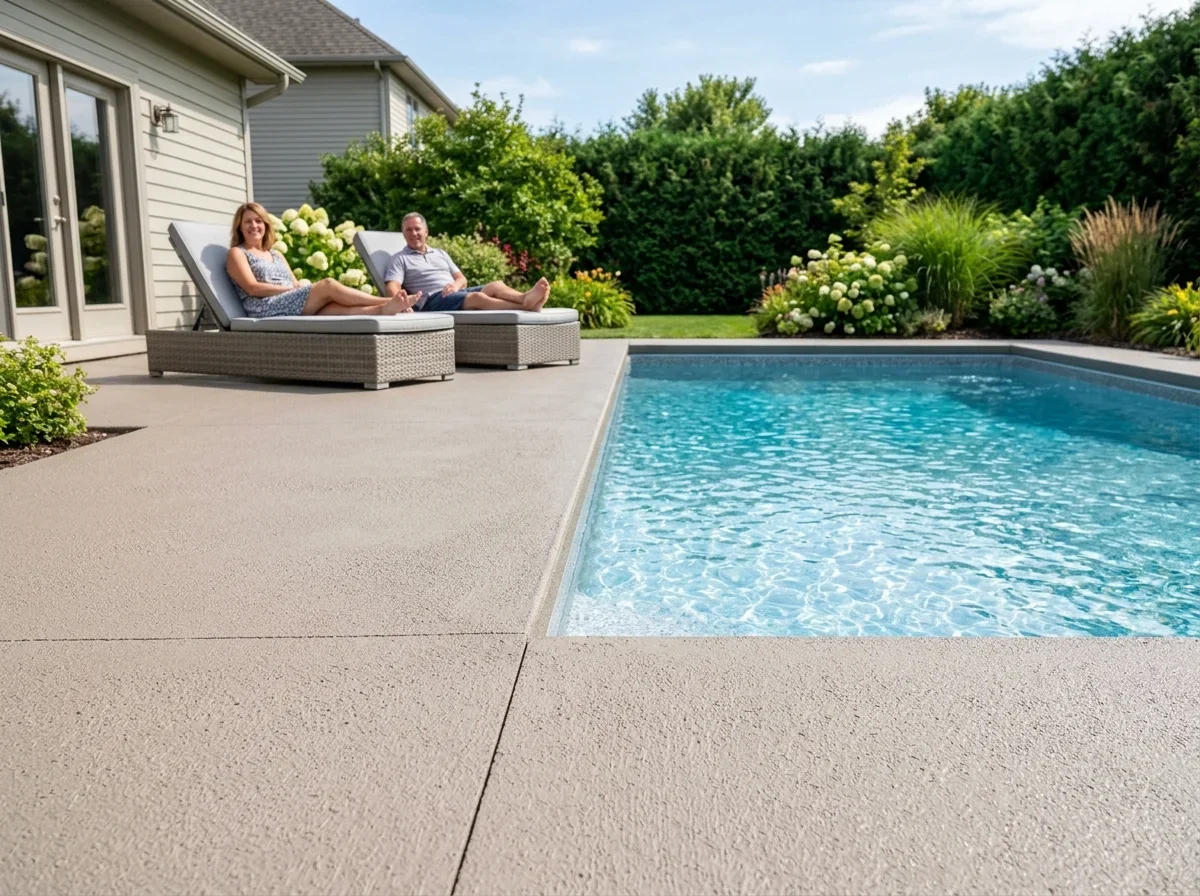
Can you resurface your pool deck yourself?
Often, yes. A deck coating on a sound, firmly bonded slab is within reach of a handy owner. The result depends far more on prep than on the product you pick.
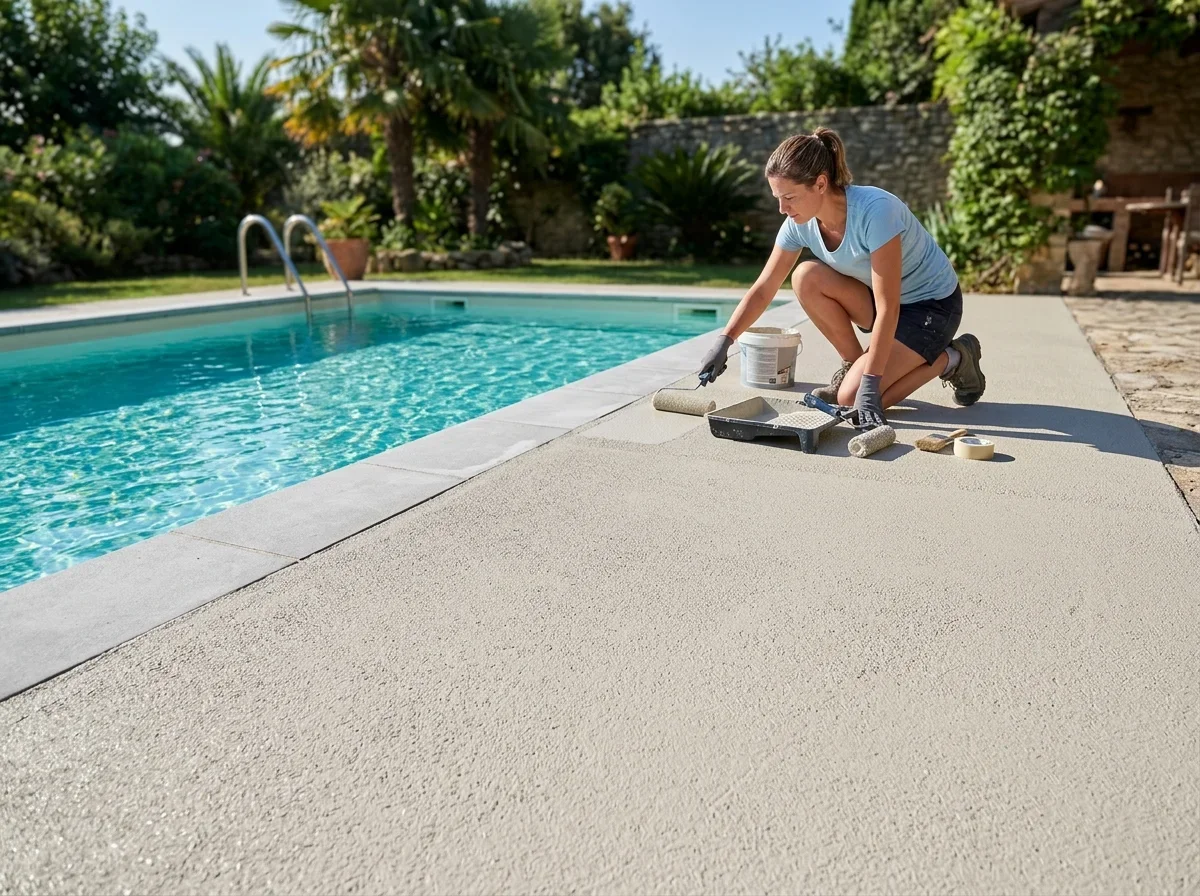
A quick go/no-go helps:
- DIY-reasonable: hairline crazing on a stable slab, with a cosmetic goal.
- Get a pro assessment: wide cracks, cracks where one side sits higher than the other, or cracks that reopen after patching.
- Pro required: any crack running toward the pool shell, partial deck replacement, or work touching the barrier, electrical or plumbing.
Keep deck work separate from the pool interior. Replastering is a different job, covered on our pool resurfacing and replastering page.
If a contractor quotes a full deck replacement, check the license class on the ROC Contractor Search. The R-6 class excludes complete replacement of decks and plaster or pebble interiors.[1]
Plan on a full weekend or more, a helper or two, and a dry stretch of weather.
Sorting and fixing pool deck cracks before resurfacing
Start by sorting the cracks. Hairline crazing is a thin, shallow web across the surface. Wider cracks, cracks with a lip where one edge sits higher, or cracks that have reopened point to movement underneath.
Manufacturers draw the same line. Neogard's application manual treats visible hairline cracks up to 1/16 inch with base-coat material, while wider cracks are routed, cleaned and filled with polyurethane sealant.[5] Tremco's pool-deck instructions also call for crack detailing before coating.[3]
How it works
How crack size sets the repair
Step 1: Sort the crack
Check for a lip or reopening
Step 2: Hairline up to 1/16 inch
Treat with base-coat material
Step 3: Wider cracks
Route, clean and fill with polyurethane sealant
A typical prep sequence looks like this:
- Clean the slab and degrease it.
- Strip old paint, sealer or coating.
- Route and fill the cracks.
- Patch spalls down to sound concrete.
- Profile the surface mechanically, then rinse and dry.
Tremco requires removal of laitance, mold, paint, sealers, curing agents and loose particles.[3] For the best cleaner, a degreaser plus a pressure wash is the usual starting point. Follow your coating's own prep sheet, since some systems restrict certain cleaners.
Step by step
Deck prep sequence
Clean
Clean the slab and degrease it.
Strip
Remove old paint, sealer or coating.
Fill cracks
Route and fill the cracks.
Patch
Patch spalls down to sound concrete.
Profile
Profile the surface mechanically, then rinse and dry.
A coating will not stop a slab that is settling. Phoenix's caliche hardpan sits a few feet down and can influence settling, so treat uneven or reopening cracks as a job for an assessment. If a crack runs near the shell, start with pool leak detection and repair instead.
Pool deck resurfacing options compared
The main choices differ in how hard they are to apply, how the surface feels in the sun, and how they deal with future cracks.
| Option | DIY difficulty | Heat and surface feel | Crack handling | Typical drawback |
|---|---|---|---|---|
| Cool deck spray coating | Moderate; needs spray technique | Designed for a cooler barefoot feel | Hairlines can be bridged; wider cracks need repair first | Surface prep and even application are demanding |
| Knockdown texture | Moderate | Textured, slip-resistant | Masks hairlines; moving cracks can reappear | Texture varies with technique |
| Paint or stain with sealer | Easiest | Can feel hot; smooth finishes can be slick | Limited | Needs frequent recoating |
| Overlay | Harder; time-limited mixing | Varies by product | Rigid layers can reflect movement | Batch and thickness inconsistencies |
| Rubber or resin coating | Moderate to hard | Cushioned, textured | Flexible systems tolerate minor movement better | Material and prep demands |
Cool deck and knockdown texture
Cool deck products are spray-applied toppings designed to stay more comfortable underfoot. Knockdown texture is sprayed, then flattened with a trowel for a mottled, grippy finish. Both reward a small test area first.
Paint, stain and sealer
Painting a pool deck can be a good idea on sound concrete. On sound concrete it can be, and it is the lowest-effort route.
The catch is grip. A smooth film gets slippery wet, so use a slip-resistant additive. DYCO's pool deck stain data sheet, for example, requires a completely dry surface and lists a two-hour touch-dry time at 77°F and 50% humidity.[4]
Overlays and rubber or resin coatings
Overlays and rubber or resin systems build thickness and can look excellent, but they are the least forgiving. Short working times make helpers essential. Judge any kit against its data sheet for prep requirements, temperature limits and crack guidance.
Why Phoenix heat complicates DIY application
Phoenix summer highs reach about 106°F, and a slab in direct sun can be hotter than the air. That makes slab temperature, not the forecast, the number to check.
Manufacturers set limits. Tremco's instructions prohibit application below 40°F or above a 110°F substrate temperature, and they bar application on damp or wet surfaces.[3] DYCO's stain sheet is tighter, with a 50°F to 90°F range for surface, material and ambient temperature.[4]
A practical plan follows from that:
- Work early in the morning or in full shade.
- Check the slab itself, not just the air.
- Never coat a damp slab or one still wearing an old sealer.
- Test a small patch before committing.
- Line up a helper if mixing and spraying are time-limited.
Large areas are the real risk, because you need to keep a wet edge across the whole pour or spray. A pool deck resurfacing pro can handle it.
Pro tip
Check the slab's own temperature before you mix anything, since a sunlit deck can run well above the air temperature and past a product's limit.
Signs a pool deck job needs a professional
Hire when cracks are structural, the deck needs partial replacement, or the job touches the barrier, electrical or plumbing.
Barrier work must meet Arizona rules, including a 4-inch sphere test for openings. Our Arizona pool barrier law guide covers the details.
Side by side
DIY or pro
DIY-reasonable
- Hairline crazing on a stable slab
- Cosmetic goal
Pro required
- Cracks running toward the pool shell
- Partial deck replacement
- Work touching the barrier, electrical or plumbing
Going DIY also changes your protections. The ROC says Arizona homeowners may be eligible for the Residential Contractors' Recovery Fund when they hire a licensed contractor, with recovery up to $30,000 per residential property owner, subject to program limits.[1] A claim generally requires a complaint and action against the contractor's bond.[2]
If you hire:
- Check the license and class on the ROC Contractor Search.
- Get a written scope covering crack prep, joint treatment, number of coats, texture and warranty exclusions.
- Agree in writing who pulls any permit.
- Confirm deck permit needs with the City of Phoenix, Mesa or Scottsdale building department.
Compare pro pricing against your materials list on our pool deck resurfacing cost page.
Checklist
Before you hire
0 of 4 ticked
Tick them off as you go. Nothing is saved or sent.
Pool deck resurfacing DIY FAQs
Can you resurface your pool yourself?
You can often coat the deck yourself if the slab is sound and the cracks are hairline. Replastering the pool interior is a separate, more specialized job.
What is the best cleaner for a concrete pool deck?
Start with a degreaser and a pressure wash, then rinse thoroughly and let the slab dry. Your coating's data sheet may restrict certain cleaners, so follow it.
How long does cool deck paint take to dry?
It depends on the product, temperature and humidity. Follow the label. One stain data sheet lists two hours to touch at 77°F and 50% humidity, but that is not universal.[4]
Is painting a pool deck a good idea?
It suits a sound slab and a cosmetic goal. Add a slip-resistant texture and expect to recoat.
Can you fix pool deck cracks yourself?
Hairline cracks, yes, with the manufacturer's method. Wide, uneven or reopening cracks need an assessment first, and the pool deck resurfacing service page explains what a pro repair involves.
What are the main pool deck resurfacing options?
Cool deck sprays, knockdown texture, paint or stain, overlays, and rubber or resin coatings. The table above compares them.
Questions
- Arizona Registrar of Contractors. "Before You Hire a Contractor." https://roc.az.gov/before-hire. Accessed October 17, 2026.
- Arizona Registrar of Contractors. "Recovery Fund." https://roc.az.gov/recovery-fund. Accessed October 17, 2026.
- Tremco. "VULKEM EWS® With Pool Decks Application Instructions." https://www.tremcosealants.com/fileshare/ApplicationInstructions_Hyland/Vulkem_EWS_Pool_Decks_AI.pdf. Accessed October 17, 2026.
- DYCO. "DYCO Pool Deck Waterborne Acrylic Stain Technical Data Sheet." https://images.thdstatic.com/catalog/pdfImages/f2/f25a9919-900d-4f80-90e7-0cfe7e1444b4.pdf. Accessed October 17, 2026.
- Neogard. "Application Manual." https://www.neogard.com/Portals/0/NeogardDocBuilder/SupportLiterature/2021-WPDC-manual.pdf. Accessed October 17, 2026.