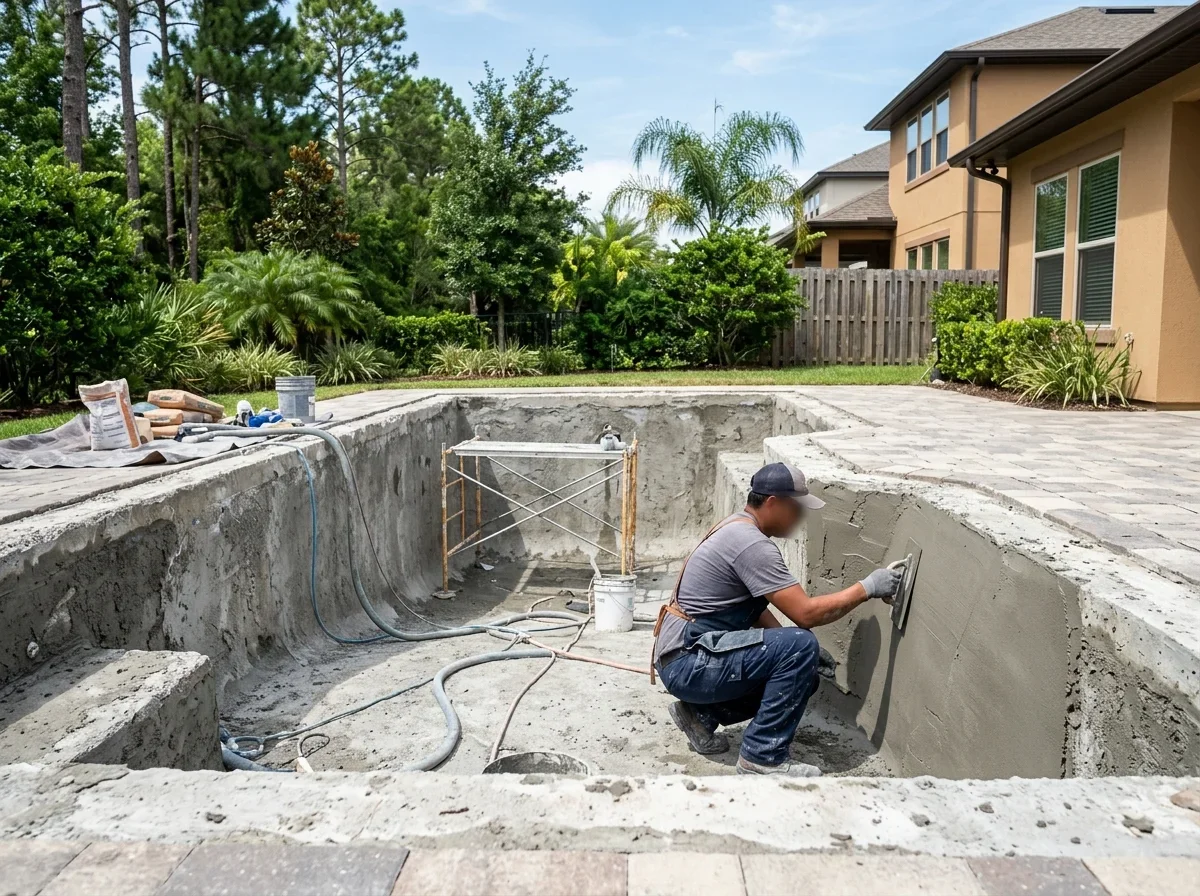
Is a permit required to resurface a pool in Phoenix?
The answer depends on scope. Confirm with the City of Phoenix before work starts. Arizona's Registrar of Contractors (ROC) says permits are the property owner's responsibility unless the contract assigns them to the contractor.[1]
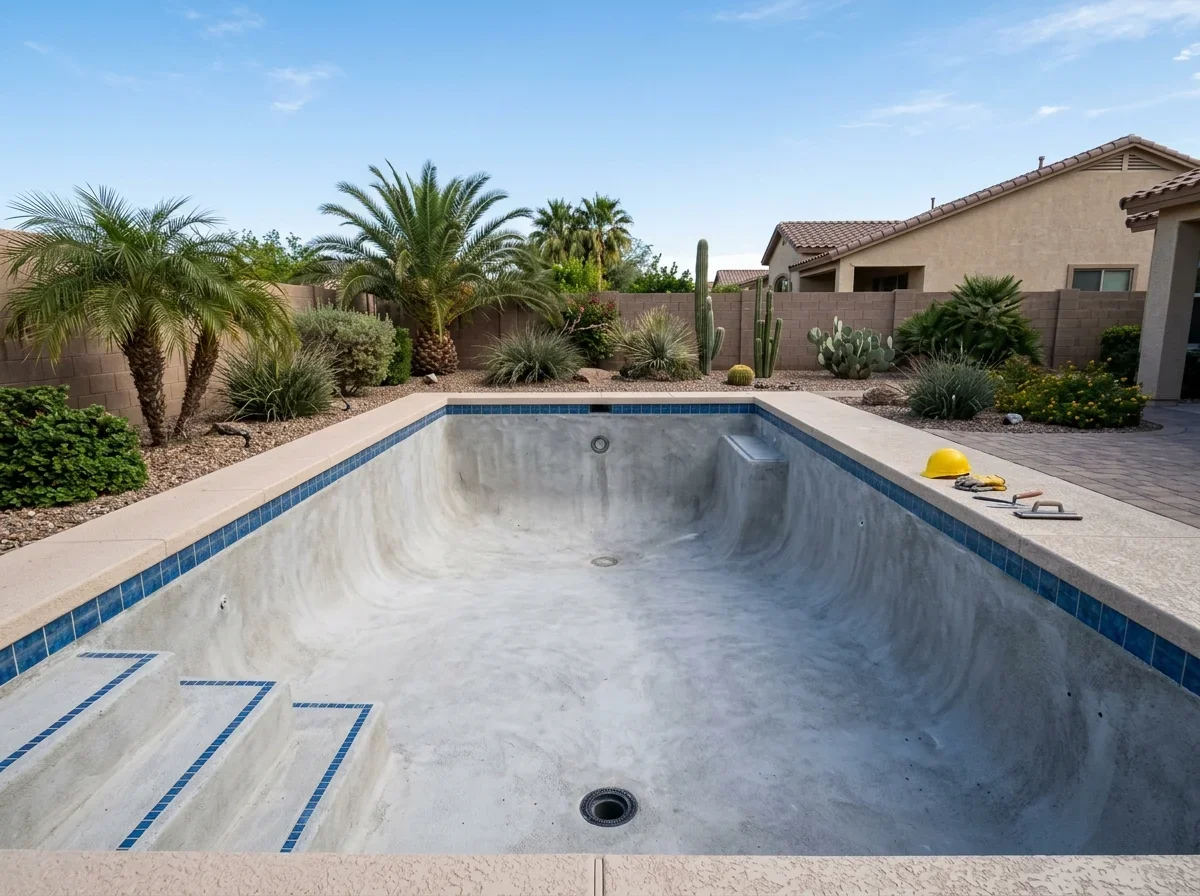
The City of Phoenix pool pages cover new pools, barriers, survey waivers and setbacks. They don't say whether swapping the interior finish needs a permit. Some third-party sites say "usually yes" and others say "usually no," and none points to a city page that settles it. Treat both claims as unconfirmed.
Cities tend to separate a like-for-like surface replacement from work that touches electrical, plumbing or structure. A replaster that stays inside that line looks very different from one that adds a light niche, new fittings or a relocated skimmer.
Side by side
Surface replacement versus added work
Like-for-like replaster
- Interior finish replaced
- No new electrical or plumbing
Scope that adds items
- Light niche
- New fittings
- Relocated skimmer
Whether the owner or the contractor files the permit
By default, you do.
The ROC states that permits are the owner's responsibility, though many contractors include permit work and fees in the contract.[1] Hiring a licensed pool company doesn't prove a city permit exists. Ask for the permit number, or written confirmation that the city said none was needed.
Put the answer in the contract. Arizona requires a written contract for any job above $1,000,[9] and the ROC says the contract should identify who obtains the permits.[1] A workable clause covers these points:
- Who determines whether the listed scope needs a permit
- Who applies and who pays the fee
- Who schedules inspections
- What happens to price and timeline if the city requires a permit after work starts
- That the permit number and final approval go to you
Check the license class first
Arizona requires a license when the total price reaches $1,000 or when the work needs a local permit.[2][10] The unlicensed-work exemption only covers jobs under $1,000 that are casual or minor, need no local permit and aren't part of a larger job or split up to avoid the license rules.[4][10] A full replaster will almost certainly exceed it.
Not every pool license covers replastering. Our guide to R-6, B-5 or KA-5 pool license classes explains which class fits.
Permit offices in Phoenix, Mesa and Scottsdale compared
Each office documents something different. As of 2026, here is what each says.
| Permit office | Documented requirement for pools | Contractor license on application | Repair or replaster threshold stated |
|---|---|---|---|
| City of Phoenix | Residential Pool/Spa Permits page; Pool Barriers requirements | Not stated on retrieved page | Not stated on retrieved page |
| Mesa | Permit for filling in an inground pool and for electrical, plumbing or mechanical changes | Contractor Licensure Verification Form required[5] | Not stated on retrieved page |
| Scottsdale | Separate permits for pools, spas and fences[7] | ROC number and Scottsdale license number asked[6] | Not stated on retrieved page |
| Maricopa County (unincorporated) | Pool, spa and barrier permits | Not stated on retrieved page | Not stated on retrieved page |
Phoenix
The Planning and Development Department handles residential pool permits. Ask the permit desk directly whether a contractor license is required for repair permits.
For barriers, Phoenix requires a new permit to enlarge, alter, repair, remove, convert or replace an approved pool barrier.[3]
Mesa
Mesa lists the Contractor Licensure Verification Form as a required document for pool permits.[5] It also requires a permit to fill in a pool and for electrical, plumbing or mechanical changes.[5] No repair-size threshold appears.
Scottsdale
The application asks for the contractor's ROC number and Scottsdale license number.[6] Owner/builders may apply through an agent with written authorization.[6] Pools, spas and fences each need their own permit.[7]
Unincorporated Maricopa County
The county issues pool, spa and barrier permits for unincorporated areas. Its pool program covers operating approvals for public and semi-public pools, not the permit a homeowner needs for a backyard replaster.
A "Phoenix" mailing address doesn't guarantee Phoenix jurisdiction. Confirm which city or county governs your parcel first. For Chandler, Tempe, Gilbert and Glendale, check each city's building department page.
Resurfacing scope that triggers added review
Scope creep is the usual culprit.
A replaster quote can grow to include new drains, plumbing, lights, equipment moves, deck work or shell repairs. Those additions can change the permit outcome even when the interior finish alone wouldn't. Our pool remodel permit guide covers that territory in more depth.
Decide
Does the scope need extra review?
Does the job add or change electrical, plumbing or structure?
If Yes
then: Ask the permit office before work starts
If No
then: Still confirm with the city and get the answer in writing
In Phoenix, a remodel that moves or adds features can bring in the survey waiver (required when the water's edge or a water feature sits under 5 feet from the property line) and the 3-foot minimum setback.[8]
Barriers are the other trigger. If the project alters the barrier, the work must meet Arizona's pool enclosure law: no opening that passes a 4-inch sphere, self-closing and self-latching gates that open outward, and a barrier at least 20 inches from the water's edge.[3] See the Arizona pool barrier law guide or pool fence and safety barrier installation for that scope.
"No permit required" also doesn't erase ROC licensing, HOA rules or drainage requirements.
Confirming the permit rule for your address
Work through these steps in order.
- List the scope. Write down every item: drain, remove plaster, replaster, tile, coping, light, plumbing fittings, deck.
- Identify your jurisdiction. Confirm whether the city or the county governs your parcel.
- Contact the permit office. Send your address and scope list, then ask: "Is a permit required? Who may apply: owner, contractor or agent? What is the fee? What inspection is required?"
- Record the answer. Get it in writing, or note the person's name, the date and any permit number.
- Verify the contractor. Use the ROC contractor search to confirm an active license, a class that covers replastering, and bond and Recovery Fund status.[1]
Keep the paper trail. A residential owner generally has two years from occupancy or completion to file an ROC complaint,[4] and owners who hire unlicensed entities have no ROC recourse.
Step by step
Confirming the rule for your address
List the scope
Write down every item, from drain to deck.
Identify your jurisdiction
Confirm whether the city or the county governs your parcel.
Contact the permit office
Send your address and scope list and ask what is required.
Record the answer
Get it in writing, or note the name, date and any permit number.
Verify the contractor
Use the ROC contractor search to check license, class, bond and Recovery Fund status.
Permit fees also feed the total, so compare them against the pool resurfacing cost guide.
Frequently asked questions
Do you need a permit to resurface a pool in Phoenix?
It depends on scope. Confirm with the city before booking. Details of the service itself are on our pool resurfacing and replastering page.
Who is responsible for pulling the pool permit?
The property owner, unless the written contract says the contractor will.[1]
Can you resurface a pool yourself in Arizona?
What are the requirements for a pool in the City of Phoenix?
New pools go through Planning and Development, with survey waiver and setback rules, and barriers must meet the state enclosure standard.[3]
What renovations do I need a permit for in Arizona?
What is the average cost to resurface a pool in Arizona?
Prices vary with size, finish and scope. See the Phoenix pool resurfacing cost guide for what drives the quote.
Questions
- Arizona Registrar of Contractors. "Before You Hire a Contractor." https://roc.az.gov/before-hire. Accessed October 17, 2026.
- Arizona Registrar of Contractors. "License Classifications." https://roc.az.gov/license-classifications. Accessed October 17, 2026.
- City of Phoenix Planning and Development Department. "Pool Barriers – Requirements." https://www.phoenix.gov/content/dam/phoenix/pddsite/documents/trt/external/dsd_trt_pdf_00144.pdf. Accessed October 17, 2026.
- Arizona Registrar of Contractors. "Contracting in Arizona? Here’s What You Need to Know!." https://roc.az.gov/news/contracting-arizona-heres-what-you-need-know. Accessed October 17, 2026.
- City of Mesa Development Services. "Residential Construction." https://www.mesaaz.gov/Business-Development/Development-Services/Building-Permit-Plan-Review/Residential-Construction. Accessed October 17, 2026.
- City of Scottsdale. "Swimming Pools & Spas Permit Application and Submittal Checklist." https://scottsdaleaz.gov/Asset429.aspx. Accessed October 17, 2026.
- City of Scottsdale. "Submittal packet for minor SFR remodel/addition." https://www.scottsdaleaz.gov/docs/default-source/scottsdaleaz/planning---develpment/permit-services/submittal-packet-for-minor-sfr-remodel-addition.pdf?sfvrsn=aec46e97_3. Accessed October 17, 2026.
- City of Phoenix Planning & Development. "Pool/Spa Residential Permits FAQ." https://www.phoenix.gov/content/dam/phoenix/pddsite/documents/trt/external/dsd_trt_pdf_00913.pdf. Accessed October 17, 2026.
- Arizona Legislature. "32-1158 - Contract requirements; provision of documents and receipt at contract signing." https://www.azleg.gov/ars/32/01158.htm. Accessed October 17, 2026.
- Arizona Legislature. "32-1121 - Persons not required to be licensed; penalties; applicability." https://www.azleg.gov/ars/32/01121.htm. Accessed October 17, 2026.