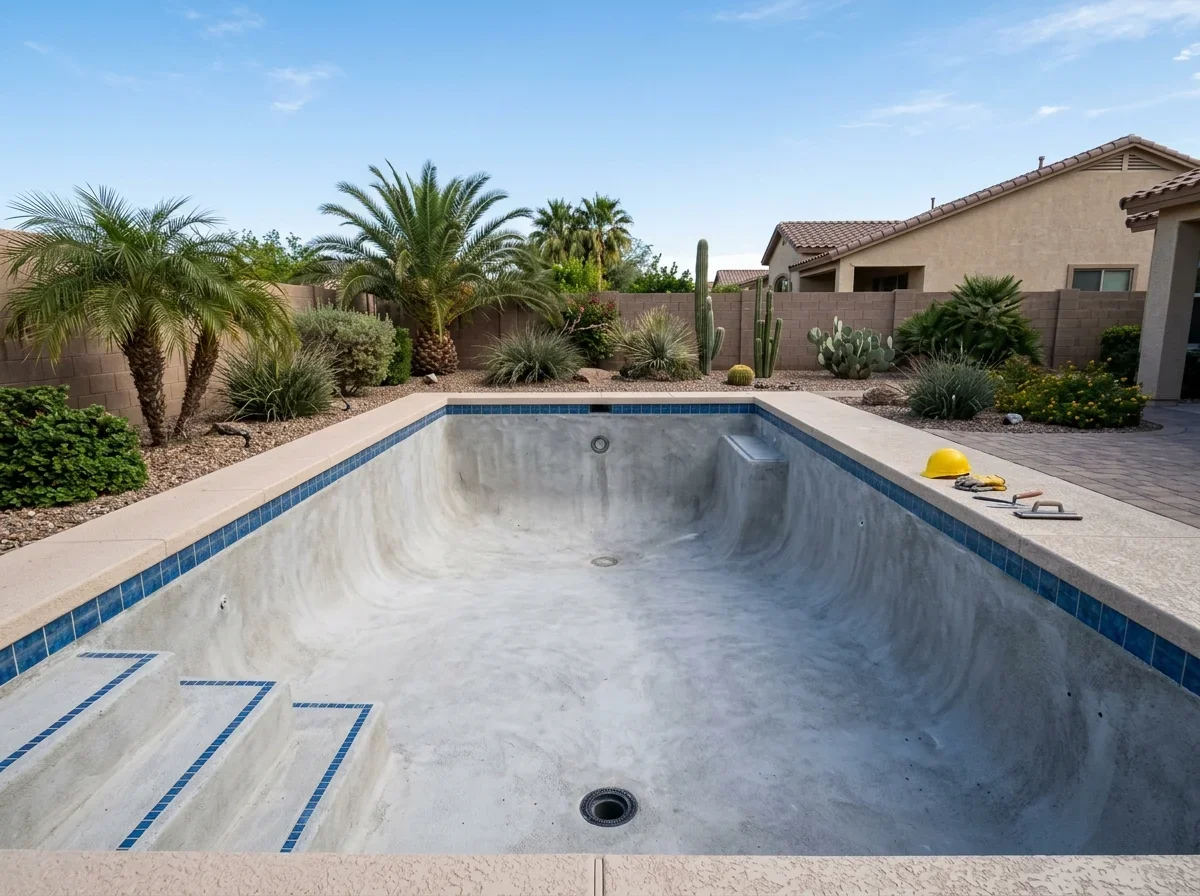
Five items a pool resurfacing quote should list
Pool resurfacing cost comes down to five things: the finish you choose, the interior surface area, how much prep the old surface needs, any tile and coping work, and draining and startup. A sound bid names each one. A weak bid folds them into a single "resurface" line.
Two bids with the same total can cover very different work. Bid A might say "resurface with plaster" and nothing else. Bid B lists chip-out, bond coat, finish, waterline tile and startup. Only Bid B shows what you are buying.
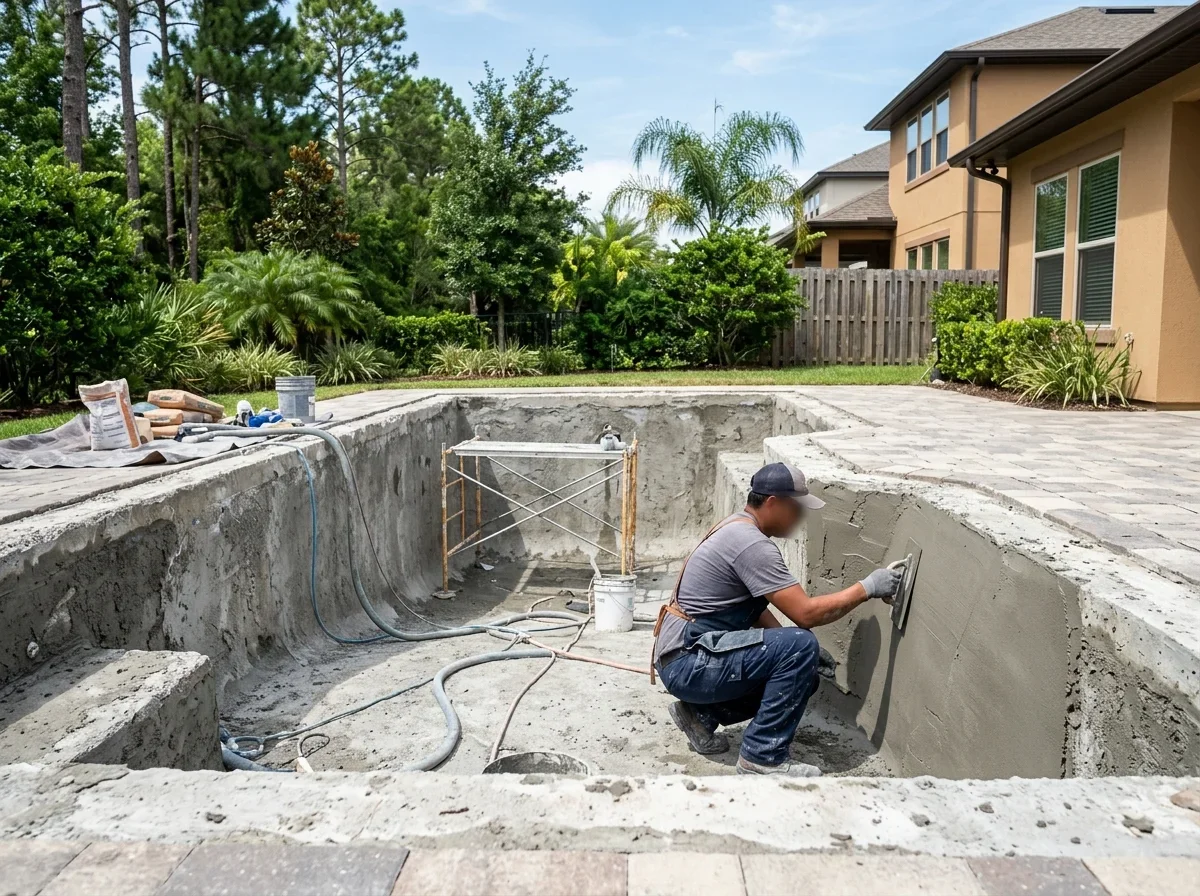
Online calculators add a wrinkle. A typical cost-guide tool asks for surface area and finish type, which means it leaves out prep and tile entirely.[2] Treat its output as a starting point, then ask each contractor to itemize.
| Bid line | What the line covers | What to ask the contractor | Effect on price |
|---|---|---|---|
| Finish material (plaster, quartz, pebble) | The product, color, texture and installation labor | Which brand and product, and what warranty comes with it? | Raises the total as you move from plaster to quartz to pebble |
| Surface prep and removal | Chipping out or preparing the old surface, bond coat, repair of hollow spots | Is this a new surface over the old, or full removal? What happens if hidden damage turns up? | A full chip-out raises the total; light prep lowers it but may not suit a failing surface |
| Tile and coping work | Waterline tile, grout, expansion joints, coping stones | Is tile around the entire pool included, or only the finish? | Often a separate line that can add a lot |
| Draining, refill and startup | Draining, fill water, brushing, chemical balancing | Who pays for the water, and who handles startup chemistry? | Usually modest, but a missing line means you pay later |
| Permit and fees | Any city permit and related fees | Who pulls the permit, and who pays? | Small, but it is often left off cheap bids |
When you are ready to collect bids, start at Pool Resurfacing and Replastering.
Finish choice and how much it moves the price
Finish is the biggest lever you control. It also explains most of the gap between a modest quote and an expensive one.
Plaster, quartz and pebble
The rank order is consistent. Standard plaster sits lowest, quartz blends in the middle, and pebble tops the list. One Phoenix-area pool company publishes ranges of $5,000 to $7,000 for standard plaster, $6,000 to $9,000 for quartz aggregate, and $8,000 to $12,000 for standard or mini pebble, with premium pebble at $10,000 to $16,000+.[1] A separate Arizona guide lists $7,000 to $12,000 for standard white plaster and $11,000 to $22,000 for NPT StoneScapes Mini Pebble.[3]
Price range
Published price ranges by finish
| Item | Low | High |
|---|---|---|
| Standard plaster | $5,000 | $7,000 |
| Quartz aggregate | $6,000 | $9,000 |
| Standard or mini pebble | $8,000 | $12,000 |
| Premium pebble | $10,000 | $16,000 |
The overlap and the gaps tell you something: published ranges are planning figures, not quotes.
Branded products such as Diamond Brite are priced by the installer, so a brand name is a line to ask about. Request the product, color and warranty in writing. For lifespan and trade-offs, see plaster vs. pebble.
Paint or epoxy as the cheap option
Paint or epoxy is the cheapest route to a fresh-looking surface. It is also a coating over the old finish, not a replacement, so it will not fix a surface that is failing underneath.
Pool size and cost: surface area matters more than gallons
Price follows interior surface area, not gallons. Two pools with the same volume can have very different areas depending on depth and shape.
To estimate area, add the floor and the walls:
- Floor: length × width
- Walls: perimeter × average depth
- Then add steps, benches, tanning ledges and any spa
Here is a 20x40 pool as geometry only. The floor is 20 × 40 = 800 square feet. The perimeter is 2 × (20 + 40) = 120 feet, so at a 5-foot average depth the walls add 600 square feet. That is roughly 1,400 square feet before steps and benches.
How it works
How to estimate surface area for a 20x40 pool
Step 1: Floor
20 × 40 = 800 square feet
Step 2: Walls
120 feet of perimeter × 5 feet average depth = 600 square feet
Step 3: Add-ons
Steps, benches, tanning ledges and any spa
For scale, one Arizona guide estimates a 10,000-gallon pool at about 340 square feet of surface area.[3] Ask the contractor to state the measured area on the bid.
If you want a per-square-foot reference, one Phoenix company's guide lists material-only costs of $4 to $6 per square foot for standard plaster, $6 to $9 for quartz and $8 to $12 for Pebble Tec. Labor, draining, prep and startup are extra.[2]
Extra work that gets added: prep, tile, coping and startup
This is where bids drift apart. Ask whether the price includes chipping out the old plaster, repairing hollow spots and applying a bond coat, or simply a new surface over the old. Those are materially different scopes.
Many Phoenix pools are decades old, so ask for a pre-bid inspection and a written rate for hidden damage found after draining.
Pro tip
Ask every contractor for a written rate for hidden damage found after draining, so a surprise repair does not become an open-ended charge.
Tile and coping are usually separate lines. For the tile side, see Pool Tile Repair and Calcium Removal.
If the bid includes coping or deck work, ask whether any barrier changes are involved. See Arizona pool fence law.
Then there is startup. Ask who pays for fill water, who brushes the new finish, and who balances the chemistry. Phoenix water is very hard, and calcium scale is a real concern early on, so get the finish manufacturer's startup instructions in writing.
A Phoenix survey waiver applies only if the job moves or adds features near a property line. See Do You Need a Permit to Resurface a Pool in Phoenix?.
Licence classes that can quote the job and what the contract should cover
Licence class is a price-comparison filter. On the Arizona Registrar of Contractors (ROC) classification list, the R-6 residential pool and spa scope excludes complete replacement of plaster or pebble interiors, while B-5 covers replastering and remodels.
A low bid from an R-6 or CR-6 holder is therefore a scope question, not a bargain. Our guide to R-6, B-5 or KA-5 walks through it.
Here is a short checklist to run before you sign:
- Look up the contractor at roc.az.gov/before-hire and confirm the license is active.
- Confirm the class on the record.
- Check bond and Recovery Fund status.
- Get a written contract.
- Settle who pulls the permit, and how payments are scheduled.
Under A.R.S. 32-1158, a contract over $1,000 must be written. It must include the contractor's name and license number, price, work description, deposit and progress-payment terms, and the ROC complaint notice.
"Licensed, bonded and insured" in an ad proves nothing by itself. Verify the record instead. More on this in Is "Licensed, Bonded and Insured" Enough?
When resurfacing is worth the money and safe ways to cut cost
Resurfacing pays off when the surface is rough, stained, or leaking through failed plaster. If water loss is the reason, confirm a leak first through Pool Leak Detection and Repair, since a new finish will not fix a plumbing leak.
Safe savings are mostly about comparison:
- Get at least three itemized bids that price the same scope.
- Bundle tile or coping work into one visit.
- Choose the finish by lifespan rather than sticker price.
Unsafe savings carry real risk. Cash deals, a skipped written contract, and door-to-door offers all leave you exposed.
Treat a very low bid as a prompt to ask what is missing. Compare prep method and exclusions before you compare totals.
Pool resurfacing cost FAQ
Is it worth resurfacing a pool?
Yes, when the surface is rough, stained or failing. If water loss is the problem, rule out a leak first.
How much to resurface a 10,000 gallon pool?
It depends on surface area, finish and prep, not gallons alone. One Arizona guide puts a 10,000-gallon pool at about 340 square feet and lists $8,500 to $14,000 for it.[3]
How much does it cost to resurface a 20,000 gallon pool?
Gallons do not set the price, area does. Ask the contractor for the measured area and finish on the bid.
What is the cheapest way to resurface a pool?
Paint or epoxy, with the limits noted above. It is a coating, not a replacement.
Is there a pool resurfacing cost calculator?
Yes. Most ask for surface area and finish, and skip prep, tile, coping and startup.[2] Use the output as a starting point, then request quotes through Pool Resurfacing and Replastering.
How much does it cost to replaster a 20x40 pool?
Use the geometry above to estimate area, then multiply by a sourced per-square-foot figure. Material-only ranges leave out labor, prep and startup,[2] so ask for itemized quotes before you budget.
Questions
- Sun America Pools & Spas. "Pool Resurfacing in Phoenix, AZ | Sun America Pools & Spas." https://sunamericapools.com/blog/pool-resurfacing-phoenix. Accessed October 17, 2026.
- PHX Pools. "Pool Resurfacing Cost Guide - Phoenix, AZ - PHX Pools." https://phxpoolresurfacing.com/resources/pool-resurfacing-cost/. Accessed October 17, 2026.
- AE Outdoor Living. "Pool Resurfacing Cost in Arizona 2026." https://aeoutdoorliving.com/pool-resurfacing-cost-arizona. Accessed October 17, 2026.