Low water flow, a wrong mode or setpoint, a closed gas supply or tripped breaker, and a lockout code are the most common reasons a pool heater is not heating. Work through the checks below in order, from look-only to hands-on, and stop at the red flags.
| Symptom | Likely area | Homeowner check | Stop and call a pro? |
|---|---|---|---|
| No power or blank display | Power supply or controls | Look at the breaker and the display | Yes, if the breaker trips again |
| Heater fires then shuts off | Low water flow | Baskets, filter, valves, bypass | Yes, if flow is good and it still shuts off |
| Lit but water stays cool | Settings or heat loss | Mode, setpoint, cover use | Not at first |
| Heats slowly | Size, weather, run time | Cover, run schedule, airflow | No, often normal |
| Error code showing | Model-specific fault | Record the code, read the manual | Yes, if it returns after a reset |
| Gas smell or water leak | Gas line or heat exchanger | Nothing, leave it alone | Yes, immediately |
Three cases: no power, cool water, or slow heating
These are different problems. Sort yours into one of three cases: no power or display, the heater fires but the water stays cool, or it heats slowly and never reaches the set temperature.
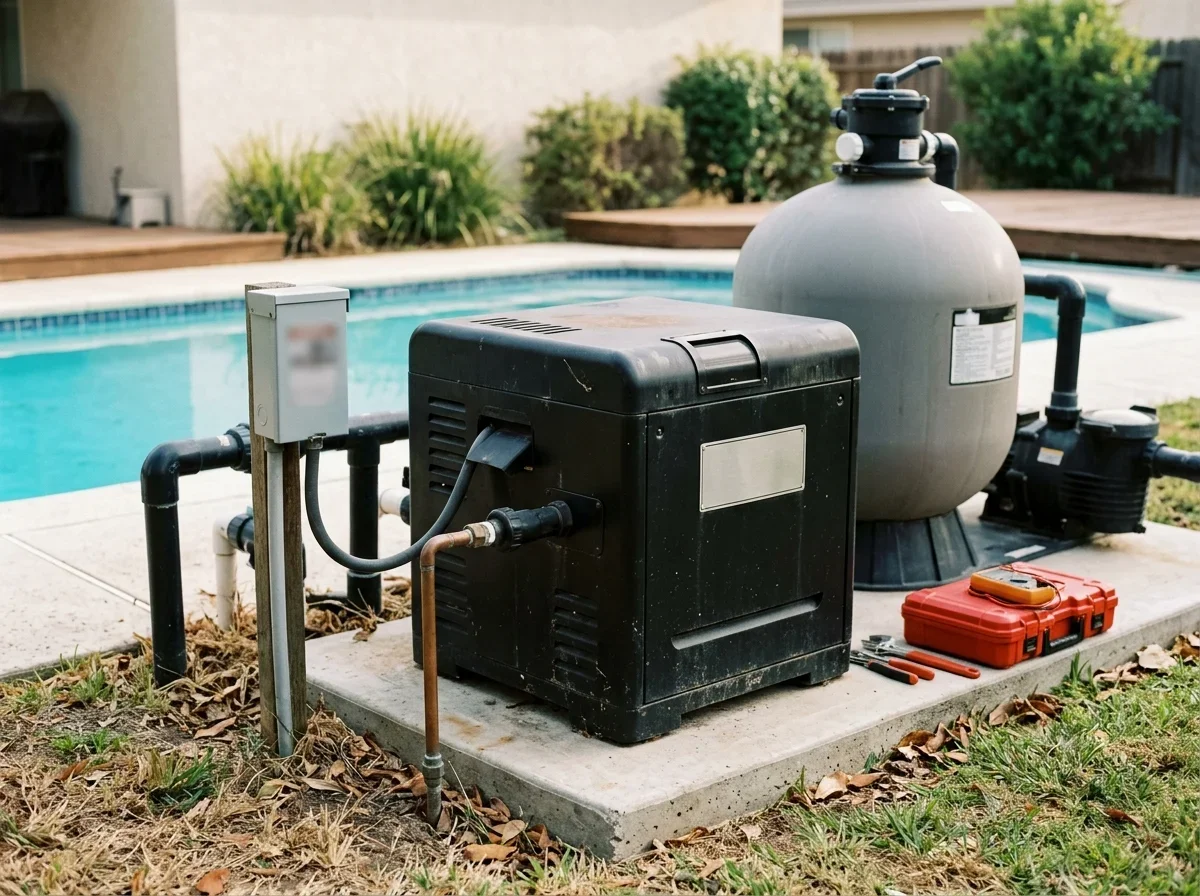
The type of heater matters too. A gas heater relies on an ignition sequence. A heat pump relies on a compressor and fan, and it will not run at all when an error condition such as a water-flow-switch fault is active.[6]
Before you check anything, write down the brand, model and serial number from the data plate, plus any code on the display. Some controls will even scroll back through the last five codes.[4]
Low water flow stops most heaters from firing
Low flow is the most common reason a heater stops firing. Heaters use a pressure or flow switch that keeps the burner or compressor from running without enough water, which is why the display can be lit while nothing heats.[6]
How the parts connect
Where water must flow to reach the heater
Skimmer and pump baskets
Keep clear
Pump
Running and primed
Filter
Check the pressure gauge
Valves
Open in the right positions
Heater bypass
A partly open bypass sends water around the heater
Heater
Return line to pool
Run these no-tools checks in order:
- Confirm the pump is running and primed, and that water is visibly returning to the pool.
- Clear the skimmer and pump baskets.
- Check the filter pressure gauge. A reading well above normal suggests a clogged filter.
- Confirm the valves are open in the right positions.
- Check any heater bypass, since one left partly open sends water around the heater.
A running pump does not guarantee adequate flow. A variable-speed pump on a low filtration schedule may not push enough water through the heater.
If the pump itself is struggling, see pool pump not working for priming, seal and capacitor checks.
Clean a dirty filter by the manufacturer's instructions, and never open a pressurized filter until the pump is off and pressure is fully relieved. If pressure stays high after cleaning, a pool filter repair may be the real fix.
Pro tip
Note the filter pressure reading when the filter is clean. A reading well above that number later is an early sign that flow is dropping and the heater may stop firing.
Settings and error lights to check
Confirm the heater is switched to pool mode rather than spa. Make sure the thermostat is set well above the current water temperature, and that no timer or schedule is blocking heat.
Then read the code or lights. Do not guess. Hayward's service guide, for example, ties its high-sense condition to specific sensor readings, which shows why codes must be read against the manual for your exact model.[5]
How it works
How to handle an error code
Step 1: Record the code
Write it down from the display
Step 2: Read it against your model's manual
Step 3: Reset only as the manual describes
Step 4: If it locks out again, call a technician
Reset the unit only as the manual describes. If it locks out again, stop and call.
Gas or power supply checks
Keep this tier to looking only. Check that the breaker has not tripped, the gas shutoff handle is open, and a propane tank is not empty if you use one.
Stop here: do not open the cabinet or touch gas lines, pilot tubing, orifices or wiring. Arizona's R-6 pool license excludes gas lines and electrical work beyond the first disconnect, so these jobs may belong to another licensed trade.
If you smell rotten eggs or hear hissing, leave the area, avoid switches and flames, and call 911 and your gas utility from a safe distance.[1][2]
The Arizona Corporation Commission likewise advises contacting your gas company first and calling 911 in an emergency.[3]
Return water runs warm, not hot
Expect mildly warm, not hot. A heater adds only a limited amount of heat on each pass, so the return line should feel gently warmer than the pool. Your manual lists the rated rise for your model.
Slow heating on a cool desert night can also be normal. Evaporation and radiative loss at night can erase much of the day's progress, especially with no cover and short run times. Heat pumps in particular lose output as the air cools, so judge them during the warmest part of the day.
If you want warmth without a working heater, a solar cover is the simplest step, since it cuts evaporation and overnight loss.
When to stop and call a licensed technician
Stop here for any of these:
- A gas smell, burning smell or scorch marks
- Water leaking from the heater
- Repeated lockouts
- Clicking with no ignition
- Breakers that trip
- Soot or odd flames
Phoenix-area companies' own websites, checked October 2026, most often list diagnostic fees of $85 to $95, with a full spread of $75 to $165. Ask for an itemized written quote for the repair itself.
Key takeaways
- Check flow, settings and codes before calling anyone
- Never open the cabinet or touch gas lines or wiring
- Diagnostic fees most often run $85 to $95
- Ask for an itemized written quote for the repair
Before you hire, look up the company on the Arizona Registrar of Contractors search at roc.az.gov/before-hire. Confirm the license is active, that the class (R-6, CR-6, B-5 or KA-5) covers the work, and check bond and Recovery Fund status.
Ask directly: "Does your license cover the gas or electrical part of this repair, or will someone else handle it?" Our guide to Arizona pool license classes explains the differences.
Checklist
Before you hire a pool technician
0 of 6 ticked
Tick them off as you go. Nothing is saved or sent.
Jobs over $1,000 need a written contract showing the license number and the ROC complaint notice. "Licensed, bonded and insured" in an ad proves nothing, so ask for proof of workers' compensation.
For diagnosis in Phoenix, Mesa, Scottsdale, Tempe, Chandler and Gilbert, see pool heater repair.
Pool heater not heating FAQ
How to make a pool warmer without a heater?
Use a solar cover, add solar heating, and reduce evaporation. Keeping the pool covered when idle, especially overnight, holds in the heat you already have.
Why does my pool heater not ignite?
Check flow first, then the gas supply (handle open, propane level) and any error code. Ignition parts sit inside the cabinet, so repeated failures or clicking without a flame mean a licensed technician.
Why is my heat not getting up to set temperature?
Confirm the setpoint, mode and run schedule, then check flow and the cover. Undersized equipment, cool nights and heat pump limits can also keep the pool short of the target.
How warm should water be coming out of a pool heater?
Only mildly warm. Each pass adds a limited rise, and your manual lists the rated figure for your model.
Why is my pool heater on but the water is cold?
The display can be lit while the burner or compressor is locked out for low flow, a code or a closed gas supply. Check the pump, filter, valves, bypass and fault code.
Can a dirty pool filter stop a heater from working?
Yes. A clogged filter restricts circulation enough that the flow or pressure switch can keep the heater from firing. Clean it safely, then retest.
Questions
- City of Mesa. "Energy Safety & Education." https://www.mesaaz.gov/Utilities/Energy/Energy-Safety-Education. Accessed October 17, 2026.
- City of Mesa. "Gas Information for Emergency Responders & Public Officials." https://www.mesaaz.gov/Utilities/Energy/Energy-Information-for-Gas-Electric-Construction/Gas-for-Emergency-and-Officials. Accessed October 17, 2026.
- Arizona Corporation Commission. "Utilities FAQs." https://www.azcc.gov/faqs/utilities-faqs. Accessed October 17, 2026.
- Pentair. "ETi 400 Quick Reference Guide." https://flowandfiltrationsolutions.pentair.com/content/dam/extranet/nam/pentair-pool/residential/heaters/eti-400-eti-250/eti400-quickref-english.pdf. Accessed October 17, 2026.
- Hayward Pool Products. "Universal H Series Heaters Technical Service Guide." https://ca.hayward.com/media/akeneo_connector/asset_files/U/H/UHS16b_UHS_TSG_163f.pdf. Accessed October 17, 2026.
- HeatPumps4Pools. "Swimming Pool Heat Pump User Manual." https://heatpumps4pools.com/myfiles/file/ZHDVT-User-Manual.pdf. Accessed October 17, 2026.