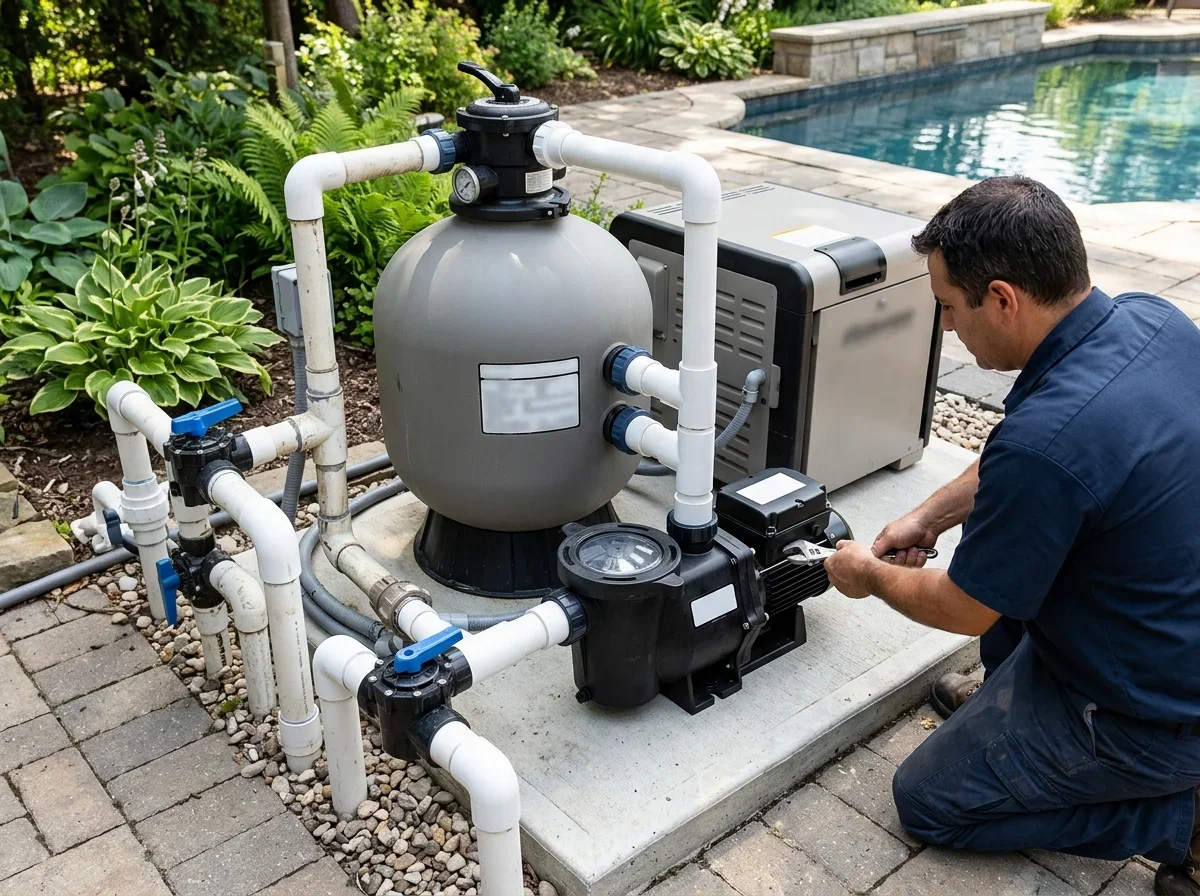
What is your pool pump doing? Start with the symptom
Match what you see and hear to a row below. The owner checks are visual and done with power off. Everything in the last column belongs to a licensed tech.
| Symptom | Likely cause | Owner check | Call a licensed tech when |
|---|---|---|---|
| No sound, no power | Tripped breaker or GFCI, timer off, power fault | Look at the timer setting and the breaker and GFCI status | The breaker is on and the pump is still dead, or any wiring looks damaged |
| Hum, no spin | Failed start capacitor, jammed impeller or tired bearings | Switch the pump off at once; with power off, look for debris at the impeller | The shaft turns stiffly, or the cause is not obvious |
| Runs, no prime or weak flow | Low water, air leak on the suction side, full basket, closed valve, clogged line | Check water level, baskets, lid and O-ring, and valve positions | Flow stays weak with a clean basket and sealed lid |
| Leak at the motor shaft | Worn shaft seal | Note where the drip is and switch the pump off | Any drip between the wet end and the motor |
| Leak at lid or unions | Dry or worn O-ring, loose union | Reseat the lid and inspect the O-ring | A union or housing seam still weeps |
| Trips breaker | Wet components, motor fault, water in the motor | Reset once after checking for moisture | It trips a second time |
Power comes first. Pentair's manual says to disconnect power at the circuit breaker before servicing,[1] and Fluidra adds that you should not do maintenance with wet hands or on wet equipment.[3] Pumps should also sit on a GFCI-protected circuit that you test routinely.[2]
If the pump is fine and the water stays cold, see pool heater not heating.
A pool pump that hums but will not spin
A hum with no spin means the motor is getting power but the shaft is not turning. The usual suspects are a failed start capacitor, a jammed impeller or seized bearings.
How the parts connect
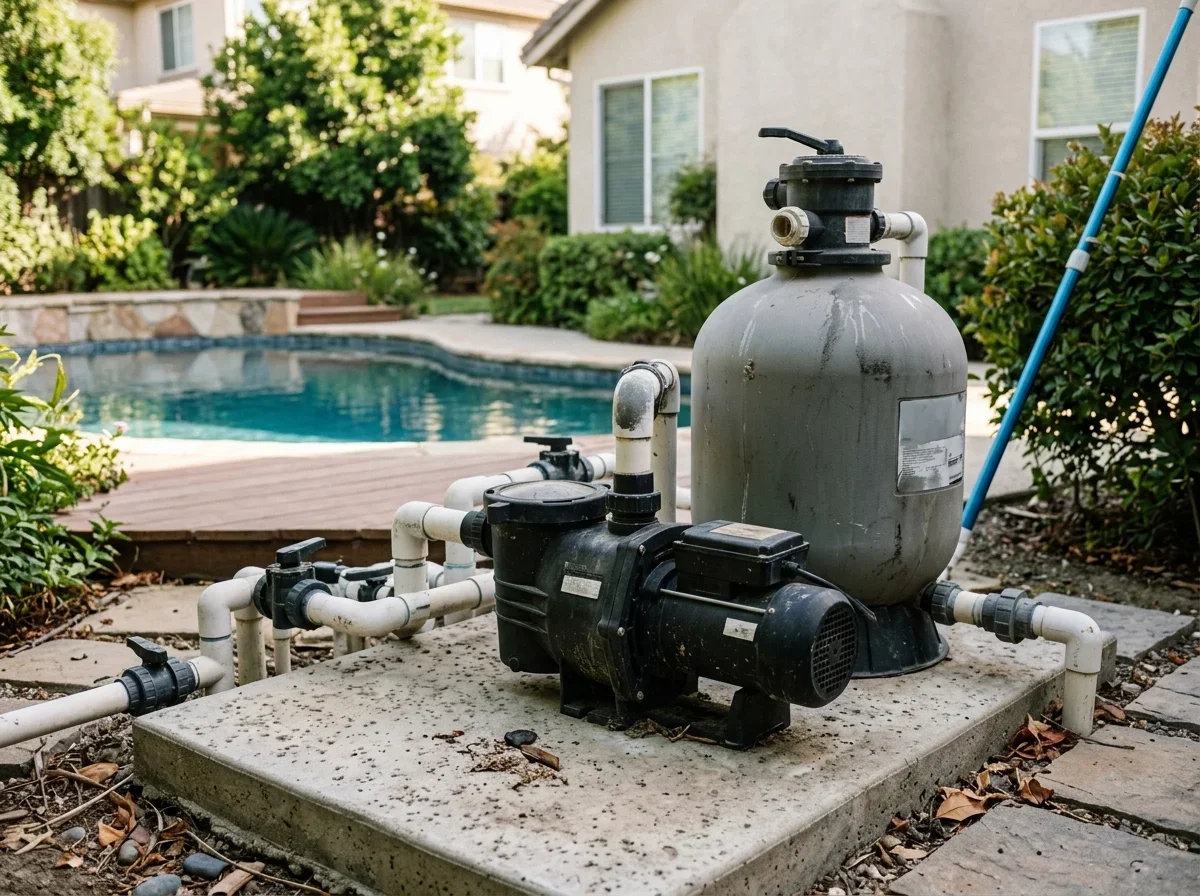
Where the hum-and-no-spin parts sit
Strainer basket
Catches debris before the impeller
Impeller
Can jam on debris
Shaft seal
Between the wet end and the motor
Bearings
Gritty or noisy when worn
Start capacitor
Behind the motor cover
Switch it off right away. A motor left humming heats up fast and can turn a small repair into a dead motor.
Capacitor checks and replacement
A start capacitor gives the motor its kick. When it fails, the motor hums and may not move at all. The part is cheap, but it is also the hazard: Pentair warns that the capacitor bank can hold a 230-volt charge even with the power off.[1]
It sits behind the motor cover, so capacitor replacement is tech work, not a weekend job. Fluidra likewise says to contact a qualified service engineer after a breakdown instead of attempting repairs.[3]
Pro tip
Treat the capacitor cover as a no-go for owners: the part can hold a charge with the power off, so leave it to a licensed tech.
When the motor itself is the problem
With the breaker off, look for debris at the impeller through the open basket. A shaft that will not turn freely suggests a jammed impeller or bad bearings. A gritty or noisy turn points to bearings, which means the motor is near the end.
Electrical work has a licensing edge too. The Arizona Registrar of Contractors (ROC) R-6 scope excludes "electrical work beyond the first disconnect." Rewiring a motor feed or replacing a breaker is not the same as swapping a capacitor, so confirm the class covers the job.
Why a pool pump will not prime or move water
Most "won't prime" calls are air getting into the suction side, not a dead pump. Work through the causes in this order: low water level, a full strainer basket, a stuck skimmer weir, a dry or cracked lid O-ring, a closed valve, and a clogged line.
How it works
Priming checks in order
Step 1: Low water level
Step 2: Full strainer basket
Step 3: Stuck skimmer weir
Step 4: Dry or cracked lid O-ring
Step 5: Closed valve
Step 6: Clogged line
Fill the pump basket housing with water, seat the lid evenly, and restart. If it primes briefly and then loses it, an air leak is the likely reason. Check the lid O-ring, drain plugs and suction-side unions, and tighten plastic unions by hand, not with tools.
Never let the pump run dry while you troubleshoot. Pentair states that dry running can damage the mechanical seal and cause leaks.[1]
A clean basket and a sealed lid with still-weak flow can mean a restricted filter, covered in pool filter repair and replacement. A cracked housing or damaged impeller is a wet-end repair for a tech.
Pump failures after rain or monsoon storms
Monsoon season (July to September) brings debris and power events. Check the basket for leaves and silt, look at the GFCI, and have a tech inspect the timer box if you suspect water inside.[2]
Why is my pool pump leaking? Shaft seal and seal replacement
Find the source before you decide anything. Lid O-rings, unions and drain plugs are cheap and visible. A housing seam is more serious.
A drip near the motor shaft, where the wet end meets the motor, points to the shaft seal. That one needs quick action. A failed shaft seal lets water travel toward the motor bearings, and it can even show up later as breaker trips. Switch the pump off and arrange an inspection.
Shaft seal replacement is a sound repair when the motor is healthy. If the bearings are already rusty or noisy, replacing the motor or pump is usually the better route.[1]
If the water level keeps dropping and you cannot find a pump leak, the loss is elsewhere. See pool leak detection and repair.
Resetting a pool pump that trips or will not start
Reset the breaker once, after checking for standing water or obvious moisture. Also check the timer, the GFCI, and any reset button on the motor (location varies, so use your manual).
Checklist
Before you reset the pump
0 of 5 ticked
Tick them off as you go. Nothing is saved or sent.
If it trips again, stop. A second trip points to a wiring fault, water in the motor or failing windings. Resetting repeatedly will not fix any of those.
A motor that shuts itself off may be overheating, not electrically faulty. Phoenix summer highs reach about 106°F, and a motor in direct sun or a closed enclosure runs hotter. Check airflow, shade and a blocked strainer, let it cool, and restart once.
Cracked or brittle wire jackets or conduit near the pump are reasons to stop and call a licensed tech.
Repair or replacement, and Phoenix service providers
Cheap-part signs are a capacitor, a seal or an O-ring on an otherwise sound pump. Replacement signs are noisy or rusty bearings, burned windings, a cracked housing or repeated breaker trips.
Phoenix-area pool companies' own websites, checked October 2026, list diagnostic or service-call fees mostly from $85 to $95. They show minor pump repairs at $200-$400 and motor rebuilding or replacement at $350-$700. These are generic guides, not quotes, so get an itemized written estimate.
Key takeaways
- Service-call fees mostly run $85 to $95
- Minor pump repairs are shown at $200-$400
- Motor rebuilding or replacement is shown at $350-$700
- Capacitors, seals and O-rings are cheap-part repairs
- Noisy bearings, burned windings or repeated trips point to replacement
Once repair stops making sense, see pool pump replacement cost. Replacements may also need to meet energy-efficiency rules, which the Pool & Hot Tub Alliance says apply to many pumps replaced after July 19, 2021.[4]
Arizona requires an ROC license for pool repair. R-6 or CR-6 covers service and minor repair, and B-5, B-6, KA-5 or KA-6 cover broader work. Check the class, bond and Recovery Fund status on the ROC Contractor Search.
The ROC states that the Recovery Fund pays up to $30,000 per residential property owner. For the full class breakdown, see R-6, B-5 or KA-5 license classes.
Any contract over $1,000 must be in writing with the license number and the ROC complaint notice. For hands-on service, start with pool pump repair and replacement.
Pool pump not working FAQ
How do you know if your pool pump is blown?
Signs include a locked or gritty shaft, repeated breaker trips, a burning smell or a motor that hums and never starts. See when the motor itself is the problem.
How do I reset a pool pump motor?
Reset the breaker once, check the timer and GFCI, and use the motor reset button if your model has one. A second trip means stop. See the reset section.
How many years does a pool pump usually last?
Lifespan varies by model, run time and care. Check the warranty and manual for your pump. A pump that is old and has several symptoms is a replacement candidate.
My pool pump isn't pumping water. What could be the problem?
Start with water level, baskets, the lid O-ring, valves and suction-side air leaks. See the priming section.
Why is my pool pump humming but not turning?
Usually a failed capacitor, a jammed impeller or seized bearings. Switch it off and see the hum section.
Can I replace a pool pump capacitor myself?
The part is cheap, but it can hold a charge after power is off and sits behind the motor cover.[1] Leave it to a qualified tech.
Questions
- Pentair. "MAX-E-PRO® Pool Pump Installation and User’s Guide." https://www.pentair.com/content/dam/extranet/nam/pentair-pool/residential/pumps/max-e-pro/manuals/max-e-pro-pool-pump-manual-english.pdf. Accessed October 17, 2026.
- Pentair. "SUPERFLO® VS Variable Speed Pump Installation and User’s Guide." https://www.pentair.com/content/dam/extranet/nam/pentair-pool/residential/pumps/archive/superflo-vs/manuals/superflovs-variable-speed-pump-manual-english.pdf. Accessed October 17, 2026.
- Fluidra. "General Installation and Maintenance Manual." https://fluidra.bynder.com/m/6848d9504fc2613e/original/InstallationManual_65557_EN_2022_6_EN.pdf. Accessed October 17, 2026.
- Pool & Hot Tub Alliance. "Energy Efficiency." https://www.phta.org/advocacy/state-local-advocacy/energy-efficiency/. Accessed October 17, 2026.