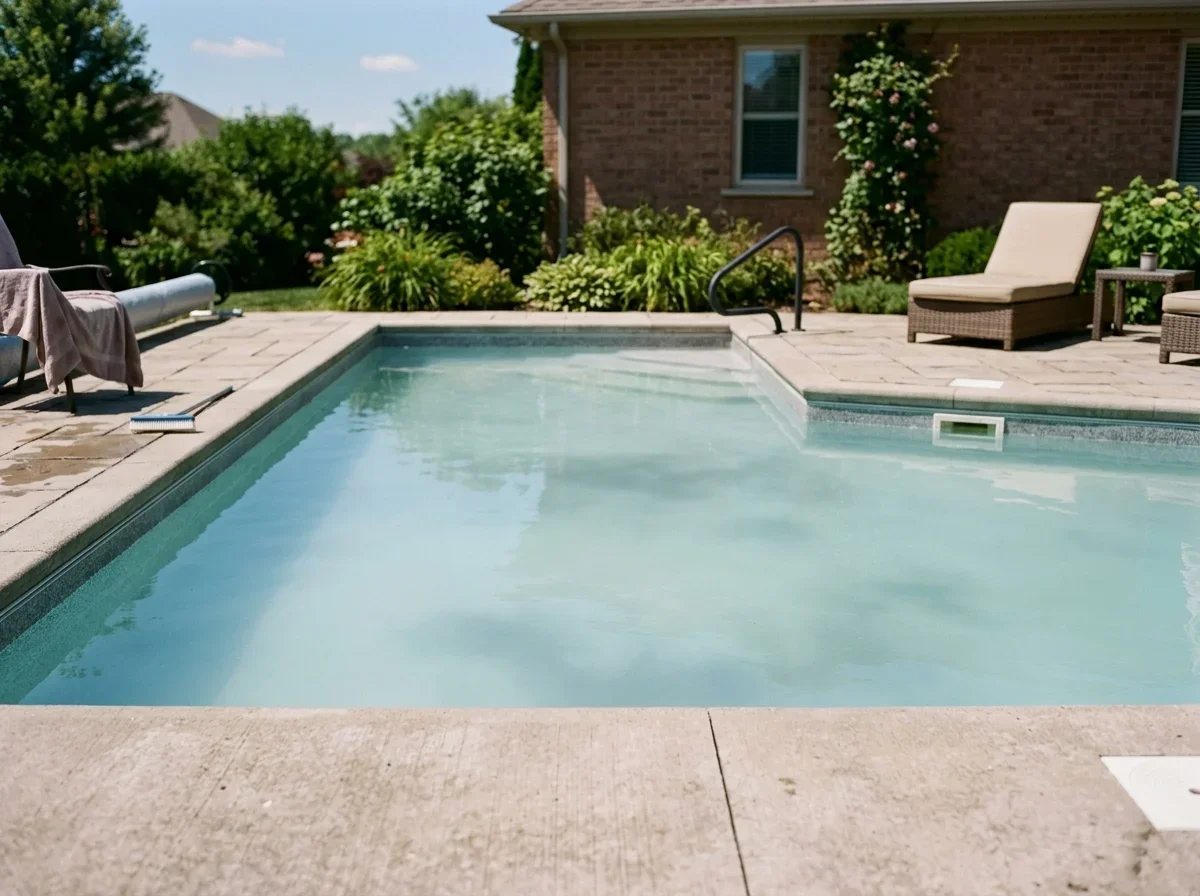
First steps when your pool turns green
Stay calm and keep everyone out of the water. A green or cloudy pool can hide hazards on the bottom, and algae can make it hard to keep a chlorine residual.[5]
Your first 15 minutes look like this: net out leaves and debris, confirm the pump is running and primed, and empty the skimmer and pump baskets. If water isn't moving, nothing else you do will work well.
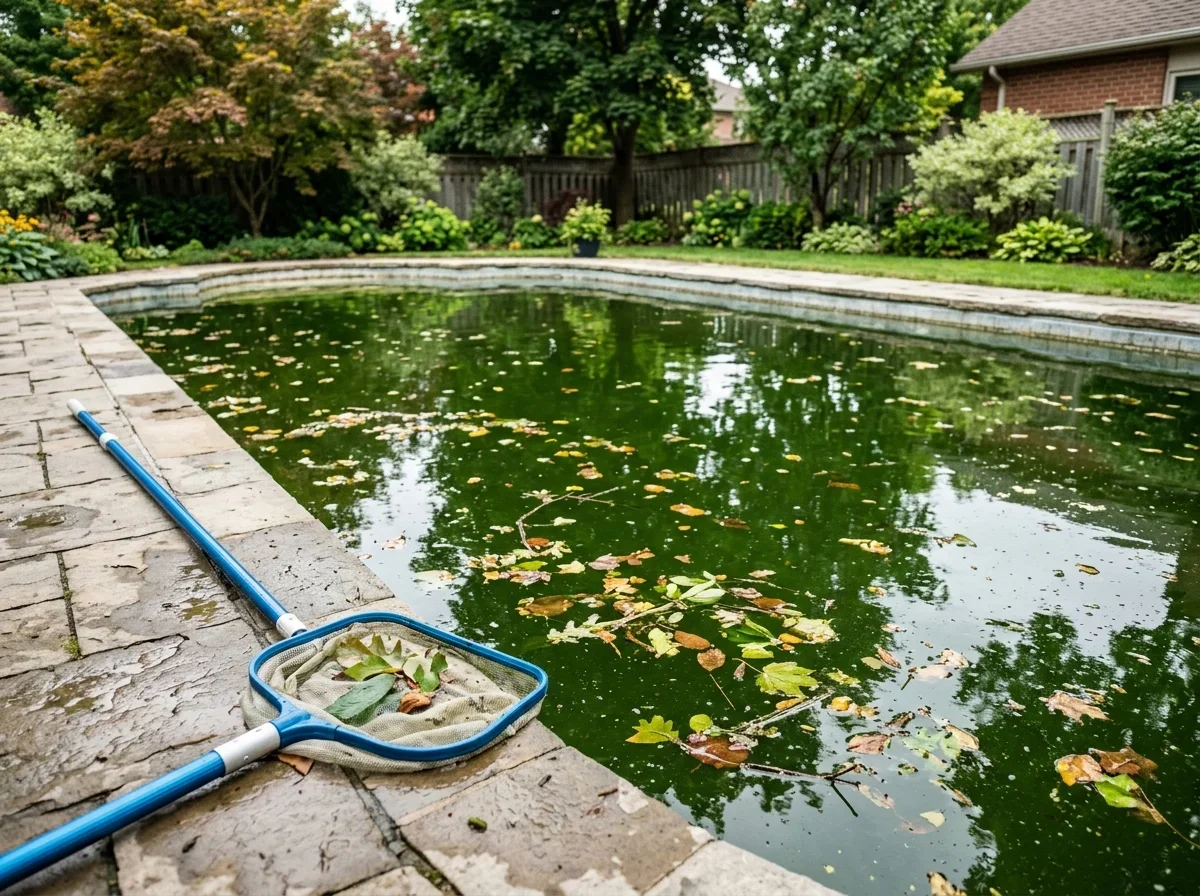
A pool that turns green in June through August may have a circulation problem rather than a chemistry problem.
Check what kind of green you have
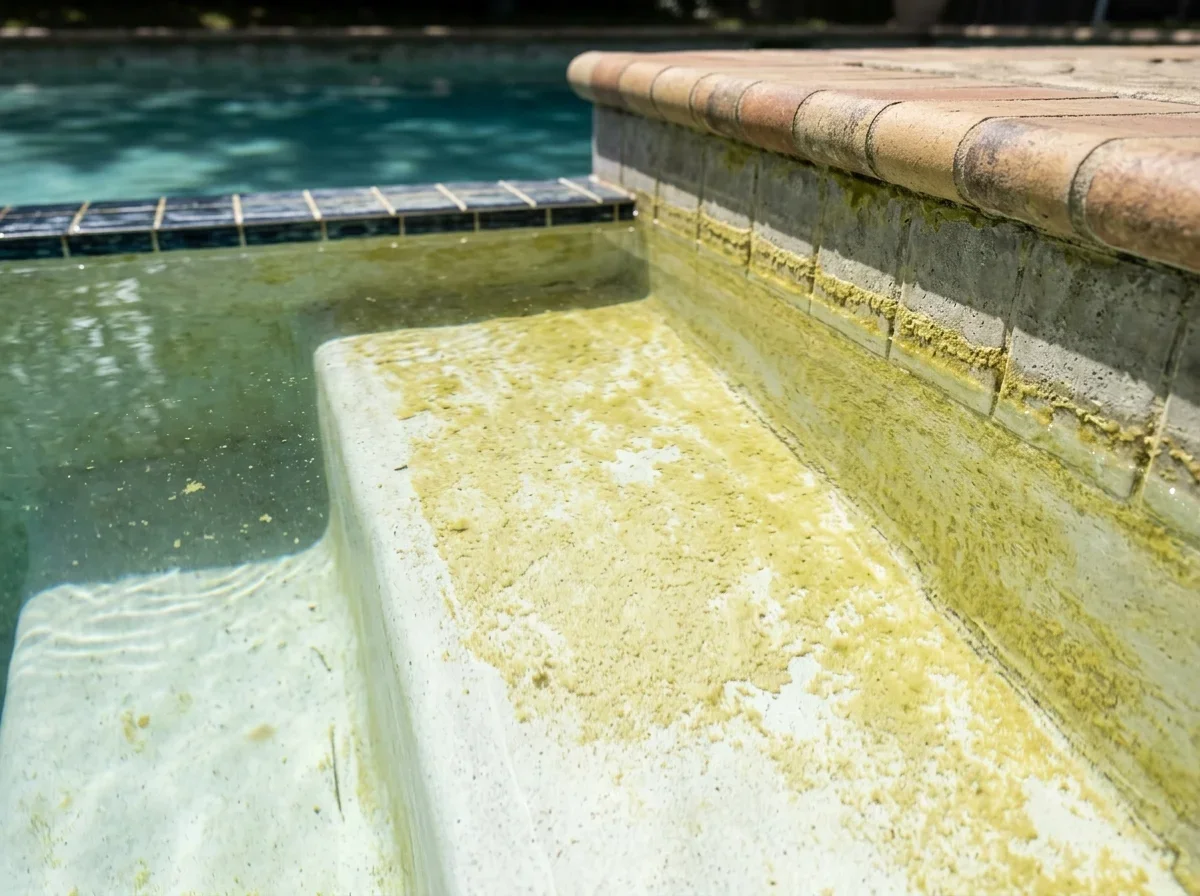
Before you buy chemicals, identify the algae. Our guide to yellow-green algae helps you tell the types apart.
Two odd cases deserve a closer look:
- Green with high chlorine on the test kit: Algae can consume chlorine quickly, so a single reading may not tell the whole story.[5] Retest, and consider whether a dissolved metal such as copper or iron is tinting the water. Adding more shock won't fix a metal problem.
- Looks green but the water is clear: That points away from live algae. Think metals, surface staining, or a finish issue, and have the water tested before you treat it.
Step-by-step method for cleaning a green pool
Follow the order and you waste fewer chemicals.
Step by step
Green pool cleanup order
Restore circulation
Chemicals dosed into still water don't distribute.
Remove debris
Leaves and organic matter consume chlorine you need for the algae.
Test and balance pH
Improper pH reduces chlorine effectiveness.
Brush every surface
Brushing exposes algae so sanitizer can reach it.
Shock
Superchlorination is an established approach for algae.
Run the filter continuously
The filter is what removes dead algae.
Clean the filter repeatedly
Algae loads clog it fast.
Vacuum the dead algae
Remove what settles so it doesn't cloud the water again.
- Restore circulation. Chemicals dosed into still water don't distribute.
- Remove debris. Leaves and organic matter consume chlorine you need for the algae.
- Test and balance pH. Improper pH reduces chlorine effectiveness.[2]
- Brush every surface. Brushing exposes algae so sanitizer can reach it.
- Shock. Superchlorination is an established approach for algae.[5]
- Run the filter continuously. The filter is what removes dead algae.
- Clean the filter repeatedly. Algae loads clog it fast.
- Vacuum the dead algae. Remove what settles so it doesn't cloud the water again.
Get the water moving and clear debris
Check that the pump primes, the returns are pushing water, and valves are set correctly. If the pump won't prime or flow is weak, see our pool pump troubleshooting guide before touching chemicals.
Note the filter pressure gauge reading now, ideally from a clean filter, as your baseline.
Test and balance before you shock
Test before you dose. The CDC recommends pH of 7.0 to 7.8 and free chlorine of at least 1 ppm, or at least 2 ppm when using cyanuric acid or stabilized chlorine products.[1] Algae will push demand well above that during recovery, so follow your shock product's label for the dose and retest often.
Don't copy another owner's dose. Pool volume and stabilizer level differ from pool to pool.
Brush, shock and keep the filter running
Brush walls, steps, corners and shaded areas. Use a nylon brush on plaster. Then add chemicals to circulating water, wear the protective equipment on the label, and keep swimmers out.[3][4]
Never mix products. Chemicals can injure people when handled improperly.[3]
Retest every few hours while the algae is consuming chlorine, and keep brushing daily on a badly green pool.
Clean the filter and vacuum the dead algae
Compare the gauge to your clean-start baseline and clean the filter when pressure climbs.
Filter type changes the method:
- Sand: backwash.
- DE: backwash, then recharge with fresh DE.
- Cartridge: remove and rinse, with no backwash.
When dead algae has settled, vacuuming to waste (if your valve supports it) keeps it from passing back through the filter. If pressure stays high after cleaning, or the water won't clear, see pool filter repair and replacement.
| Filter type | How to clean it |
|---|---|
| Sand | Backwash |
| DE | Backwash, then recharge with fresh DE |
| Cartridge | Remove and rinse, no backwash |
Time needed to turn a green pool blue again
How long it takes depends on how bad the pool is. A pool left neglected for a long time will take more rounds of treatment.
Four things slow recovery:
- Weak circulation
- A dirty or undersized filter
- Unbalanced water
- Heavy debris load
Don't be alarmed when the water turns cloudy on the way to clear. Dead algae has to pass through the filter or be vacuumed out. Our guide to cloudy pool water covers this stage.
How it works
How dead algae leaves the pool
Step 1: Brushing loosens algae
Sanitizer can reach it
Step 2: Shock kills the algae
Step 3: Filter catches dead algae
Water may look cloudy
Step 4: Vacuum removes what settles
If the pool is still green after a full treatment cycle with verified chemistry and working circulation, a pro can find what you're missing. See green pool cleanup and water treatment.
Cleaning a green pool without draining it
Usually, yes. The normal fix is to treat and filter, not drain.
Draining can put stress on the pool structure and finish, so confirm with your finish manufacturer or a licensed pro before emptying a pool.
Side by side
Treating versus draining
Treat and filter
- The normal fix
- Keeps the pool full
Drain
- Can stress the structure and finish
- Confirm with a licensed pro first
Two common questions come up here:
- Removing algae without scrubbing: Brushing is how sanitizer reaches the algae, so skipping it slows recovery.
- Removing dead algae without a vacuum: Clarifier clumps fine particles so the filter can catch them. Flocculant settles them to the floor, where they still have to be removed.
If you do decide to drain, check your city's rules on discharging pool water first.
Signs a green pool needs a professional in Phoenix
Stop and call for help if any of these apply:
- No visible improvement after one full treatment cycle
- Filter pressure stays high after cleaning
- The pump won't prime or circulation is weak
- The pool has been green for weeks
- Stains suggest metals
Green-to-clean work is priced by the job, so ask local pool companies for a written quote. One company's site puts standard residential pool recovery at $300-$600.
Those are mostly entry prices, so ask for an itemized written quote.
Verify the license
Arizona requires an ROC license for pool service and repair. A green pool cleanup is service work, which falls under R-6 or CR-6. Our license class guide explains the difference.
Look up the record on the ROC Contractor Search. Confirm the license is active, the class covers the work, and the bond and Recovery Fund status.
Get it in writing
If a cleanup grows into equipment repair, contracts over $1,000 must be in writing with the license number, price and payment terms. Ask for a workers' compensation certificate. See licensed, bonded and insured.
To keep the pool from turning green again, look at pool service and maintenance.
Frequently asked questions about green pools
What is the fastest way to clear up a green pool?
Fix circulation first, then brush and shock on balanced water, and run the filter nonstop. Skipping steps usually costs more time than it saves.
How long does it take to make a green pool clear again?
It varies with severity. A neglected pool takes longer than a lightly green one, and cloudy water mid-recovery is normal.
Can you fix a green pool without draining?
In most cases, yes. Treat, brush and filter, and save draining for situations a licensed pro recommends.
How to get a green pool blue again?
Follow the order above: circulation, debris, balance, brush, shock, filter care, vacuum. If it stays green, test for metals and check the pump and filter, or book green pool cleanup.
Why is my pool green when the chlorine is high?
Algae can consume chlorine quickly, so retest rather than trusting one reading.[5] If chemistry is verified and it stays green, dissolved metals are a possibility. Check yellow-green algae before buying more product.
Is it safe to swim in a green pool?
No. Algae can reduce water clarity and make swimmer supervision harder.[5] Wait until the bottom is clearly visible and chemistry is back within the CDC's recommended ranges.[1]
Questions
- Centers for Disease Control and Prevention. "Home Pool and Hot Tub Water Treatment and Testing." https://www.cdc.gov/healthy-swimming/about/home-pool-and-hot-tub-water-treatment-and-testing.html. Accessed October 17, 2026.
- Centers for Disease Control and Prevention. "Guidelines for Keeping Your Pool Safe and Healthy." https://www.cdc.gov/healthy-swimming/safety/what-you-can-do-to-stay-healthy-in-swimming-pools.html. Accessed October 17, 2026.
- Centers for Disease Control and Prevention. "Pool Chemical Safety." https://www.cdc.gov/healthy-swimming/toolkit/pool-chemical-safety.html. Accessed October 17, 2026.
- Centers for Disease Control and Prevention. "Don't Get Sick When Applying Pool Chemicals." https://stacks.cdc.gov/view/cdc/229911/cdc_229911_DS1.pdf. Accessed October 17, 2026.
- Centers for Disease Control and Prevention. "Historical Reference — CDC Suggested Health and Safety Guidelines for Public Spas and Hot Tubs." https://stacks.cdc.gov/view/cdc/22076/cdc_22076_DS1.pdf. Accessed October 17, 2026.