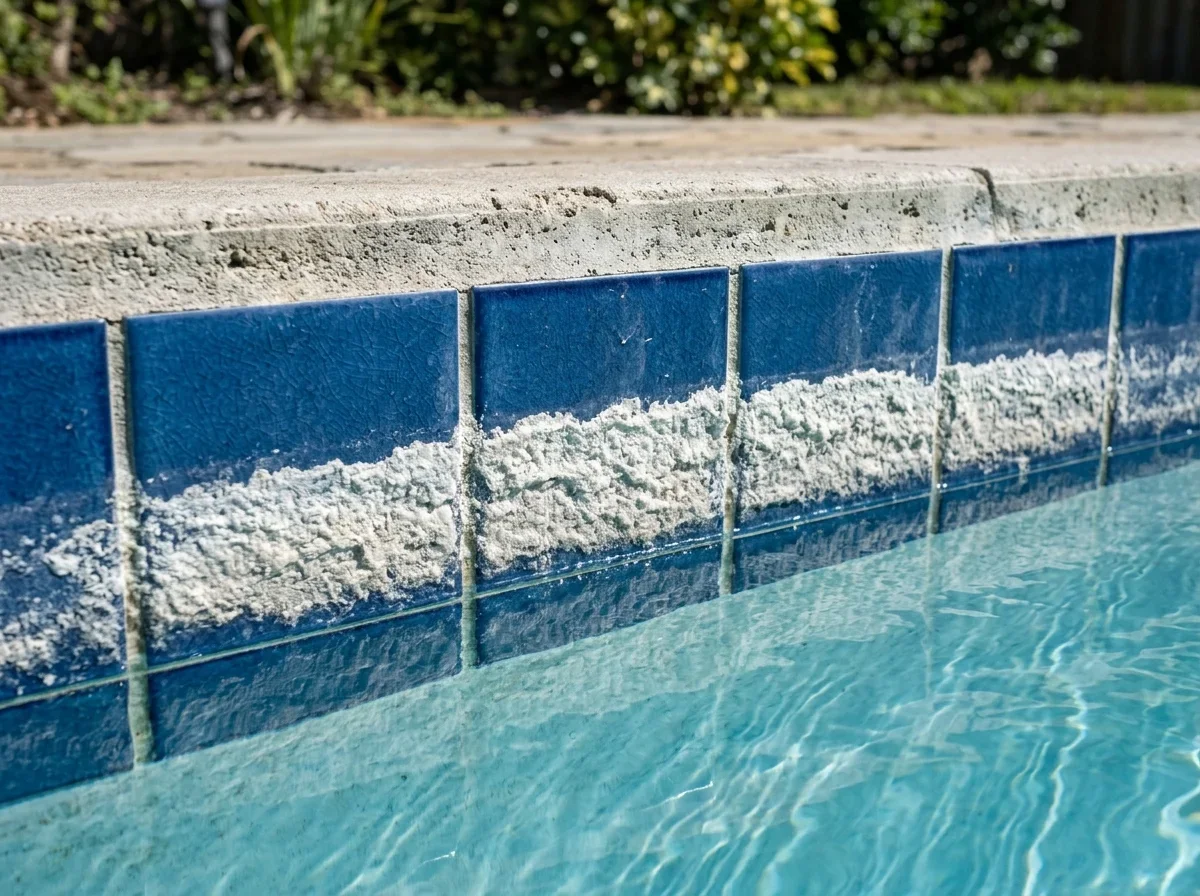
Appearance of calcium buildup on pool tile
Pool calcium buildup shows up as a flaky or crusty white, gray, or tan band right at the waterline. It feels rough under your fingers. On older or neglected pools it can creep below the line.
Before you scrub, rule out lookalikes. Algae film feels slimy and wipes off with a brush. Metal stains look rusty, brown, or greenish rather than chalky. Sunscreen and oil rings are greasy, tan, and smear rather than crumble.
Calcium carbonate vs. calcium silicate
Calcium carbonate is the common type. It is softer, flakes when scraped, and dissolves in acid. Calcium silicate is harder, glassy, and far more stubborn.
Try a quick test on a hidden spot. Put a drop of white vinegar on the crust. If it fizzes or visibly softens, you likely have carbonate. If nothing happens after a few minutes, suspect silicate or a different stain.
If you cannot tell what you are looking at, Pool Tile Repair and Calcium Removal pros can diagnose it on site.
Waterline evaporation leaves calcium behind
Water evaporates at the tile line, but the minerals dissolved in it stay behind. Over weeks and months, those minerals build into the band you see.
Chemistry decides how fast it grows. According to the Pool & Hot Tub Alliance, carbonate scale is influenced by pH, water temperature, dissolved solids, alkalinity, and calcium hardness, and water with a positive Langelier Saturation Index has a growing tendency to form scale.[1] The PHTA also notes that calcium scale can form at water lines and that calcium hardness can climb during extended drought.[2]
How the parts connect
What influences carbonate scale
pH
Water temperature
Dissolved solids
Alkalinity
Calcium hardness
Phoenix-area fill water is generally hard, and dry summer heat drives fast evaporation, so top-offs keep adding minerals. Salt systems can also push pH upward over time, which favors scale. Our chlorine vs. salt water comparison covers the tradeoffs.
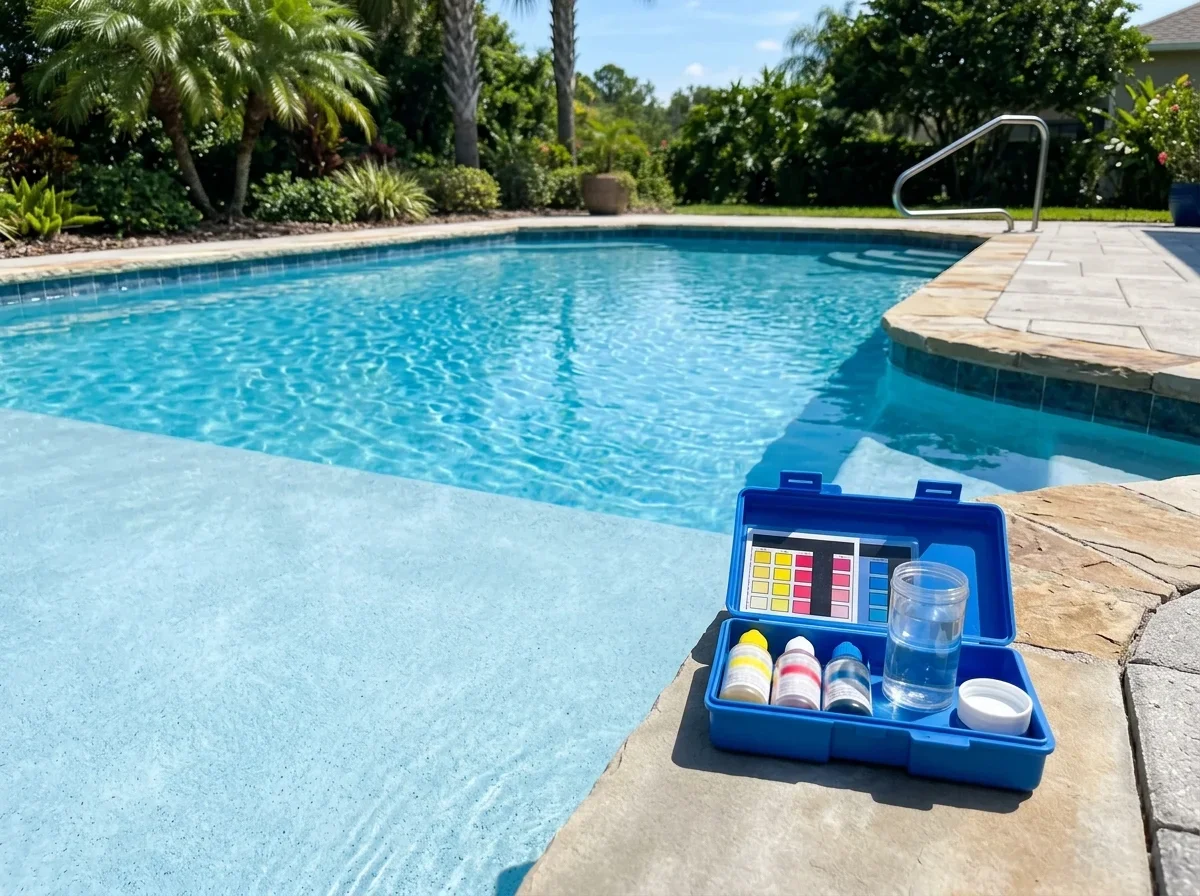
Routine testing through Pool Service and Maintenance catches drift before it leaves a mark.
Removing calcium from pool tile with the pool full
You do not need to drain the pool. Most waterline cleaning happens with the pool full, or with the level dropped a few inches below the band.
This guide is for ceramic, porcelain, and glass tile. If you have a vinyl liner, skip the pumice and acid entirely. Work on a small hidden test area first, and move up each rung only when the one before it fails.
How it works
The cleaning ladder
Step 1: Step 1: pumice and tile cleaner
Soft brush and wet pumice
Step 2: Step 2: vinegar and mild acids
Thin carbonate only
Step 3: Step 3: commercial tile calcium remover
Follow the label
Step 4: Acid wash or professional cleaning
When gentler steps fail
Step 1: pumice and a tile cleaner
Begin with a soft brush and a non-scratching pad. For small stubborn patches on compatible tile, use a pumice stone made for pool tile. Keep both the stone and the tile wet, use light pressure, and stop at once if you see scratching.
Glass and glazed tile scratch most easily. Stop here if the finish dulls or scratches, or if the crust barely changes after a few careful sessions.
Step 2: vinegar and mild acids
Spray or soak the band with white vinegar, let it sit, then scrub and rinse. This works only on thin carbonate deposits, and it is slow.
Stop here if two passes leave the band unchanged. It is either thicker than vinegar can handle or it is silicate.
Step 3: commercial tile calcium remover
A purpose-made pool tile calcium remover is the next step. Most are acid-based gels or sprays that still need brushing. Follow the label for dwell time, wear gloves and eye protection, ventilate, rinse thoroughly, and never mix acids with chlorine products.
Keep the product off grout, plaster, and natural stone unless the label says it is safe. Stop here if grout softens or erodes, the surface etches, or the deposit does not respond to a cautious spot test.
| Method | Best for | Main risk | DIY or pro |
|---|---|---|---|
| Brush and pumice stone | Small carbonate patches on compatible tile | Scratching glass or glazed tile | DIY |
| Vinegar | Thin, light carbonate | Slow; no effect on silicate | DIY |
| Commercial tile calcium remover | Moderate carbonate on glazed tile | Surface etching if misused; skin and eye hazards | DIY with care |
| Muriatic acid / acid wash | Heavy carbonate when gentler steps fail | Fumes, grout and plaster damage | Usually pro |
| Professional tile cleaning or blasting | Thick or silicate-type deposits | Surface damage from poor technique or media | Pro |
Signs that call for acid or a professional cleaner
Escalate when the crust is thick, spreading across the tile, or unmoved by the gentle steps. Muriatic acid works faster on carbonate, but it releases fumes and can damage grout, plaster, metal fittings, and stone.
Full acid washing removes a layer of plaster, so it is a last resort. Our guide on how to acid wash a pool (and when to call a pro) covers the method, and the acid wash cost guide helps you budget.
Call a pro right away if you see crust spreading below the tile line, cracked or hollow-sounding tile, grout loss, or tile scratching under pumice. Damaged or loose tile is a repair job, not a cleaning job.
Checklist
Signs to call a pro
0 of 4 ticked
Tick them off as you go. Nothing is saved or sent.
In Arizona, pool service work falls under Registrar of Contractors classes R-6 or CR-6, with repair and remodel work under B-5. Confirm the class on the ROC Contractor Search at roc.az.gov before you hire. R-6 excludes complete replacement of plaster or pebble interiors, so exposed plaster damage may need a different license, such as pool resurfacing. Our license class guide explains the differences.
Jobs over $1,000 need a written contract showing the license number, price, and payment terms.
Preventing calcium from returning
Cleaning removes the band. Balancing water stops the next one. Dropping pH alone will not dissolve a hardened deposit.
Test your water on a regular schedule and keep pH, alkalinity, and hardness in the ranges your pool professional recommends. The PHTA notes that keeping calcium carbonate within the recommended range reduces scaling and etching.[3]
Brush and wipe the waterline routinely, before deposits harden.
Pro tip
Wipe the waterline on a routine schedule, before deposits harden. A soft crust is far easier to remove than an old one.
Frequently asked questions
What does calcium build up look like in a pool?
It looks like a flaky, rough white, gray, or tan band at the waterline, sometimes spreading below it. Slimy film is more likely algae, and rusty marks suggest metals.
How to clean pool tile without draining?
Work at the waterline with the pool full, or drop the level slightly below the band. Start with a soft brush and wet pumice, then move to vinegar or a commercial tile remover.
How to get rid of pool stains?
Identify the stain first. White crust is scale, rusty or green tones suggest metal, and greasy tan rings point to oils. Each needs a different treatment.
How do I increase the calcium in my pool?
You likely need the opposite, since crust means calcium is already high or the water is scale-prone. Raising calcium is a separate adjustment made only after testing.
Will vinegar remove calcium from pool tiles?
It can soften thin carbonate deposits with repeated effort. It will not affect silicate scale or thick, old crust.
What is the best calcium remover for pool tile?
The best product is one labeled for your tile type, used as directed. If a spot test fails, Pool Tile Repair and Calcium Removal pros can take over.
Questions
- Pool & Hot Tub Alliance. "Water Balance Indexes." https://www.phta.org/pub/?id=0944f15c-1866-daac-99fb-94b844527165. Accessed October 17, 2026.
- Pool & Hot Tub Alliance. "PHTA Fact Sheet: Calcium Hardness." https://www.phta.org/pub/?id=50ffe77d-1866-daac-99fb-9719108d1367. Accessed October 17, 2026.
- Pool & Hot Tub Alliance. "Total Alkalinity in Pool and Spa Water." https://www.phta.org/pub/?id=25a114b4-1866-daac-99fb-277001b3c020. Accessed October 17, 2026.